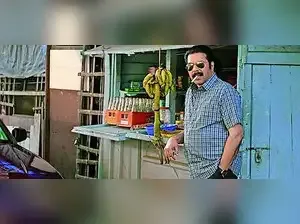
The Malayalam crime drama, Kalamkaval: The Venom Beneath, is an account of a psychopath - Stanley Das played by Mammootty - who lures women into sexual relationships before killing them. It is evidently inspired by Mohan Kumar a.k.a. Cyanide Mohan, the real-life serial killer from Karnataka convicted for murdering 20 women. Writer-director Jithin K Jose and his co-writer Jishnu Sreekumar are so focused on their male lead that they forget the essence of Mohan's strategy, which was to target young women by promising to marry them without dowry.
We gather from snatches of conversations that some of the women in Kalamkaval are widows or divorcees. But the film doesn't bother to write them with depth, making Kalamkaval an illustrative example of the damage done by shaving the politics off a story.
To understand the lost potential here, watch the 2023 Hindi streaming series Dahaad (Roar), which, too, drew on Cyanide Mohan's modus operandi and victim profile. That show created by Reema Kagti and Zoya Akhtar gave equal prominence to the women's motivations as it did to the serial killer. Dahaad was about the crushing pressure that a conservative society places on women to get married, the burden of dowry on their families, and a woman's entire worth being measured by her marital status. The women in Dahaad were, consequently, emotionally fragile.
The killer preyed on them by tapping into their vulnerability. He got away with his crimes for a long time because when they went missing, especially if they left behind notes saying they were eloping to marry, most of their families were so relieved that they did not bother to find them. The series did not centre around the male murderer or his victims, but around a dalit policewoman, played by Sonakshi Sinha, who, too, is being pestered to marry when she chances upon this case and cracks it.
In Kalamkaval, the police investigator is a man. There is not even an acknowledgement of the fact that Mammootty is about 40-50 years older than each of the female actors playing Stanley's victims. Women young enough to be his granddaughters simply fall for his character en masse, as they do with all senior Indian male superstars. Most of these women are not shown to be particularly vulnerable either.
The result is that Kalamkaval is just a stylishly shot film that offers Mammootty, also its producer, a showcase for his formidable talent. The veteran imbues Stanley with a terrifying coldness. Dahaad, in contrast, was richly insightful and emotionally compelling.
This is an unexpected role reversal. In the past decade, as Hindi cinema's quality has drastically declined, Hindi filmmakers have been repeatedly guilty of remaking films from other Indian languages, and spoiling them. Kalamkaval is not a remake, but you get my point. One of the most prominent examples is Shashank Khaitan's 2018 film, Dhadak, a remake of Nagraj Manjule's Marathi blockbuster Sairat. The original was a saga of persecution in an inter-caste romance. The Hindi remake barely mentioned caste.
Jeo Baby's 2021 Malayalam sleeper hit, The Great Indian Kitchen, was about the oppression of a stay-at-home wife in a patriarchal, upper-caste Hindu home, set against the backdrop of the campaign demanding women's entry into the Sabarimala temple. Caste and religion were virtually deleted from the 2025 Hindi remake, Arati Kadav's Mrs.
These Hindi films were ruined by their industry's long-running apathy towards caste, in addition to a fear of socio-political commentary in an era of hyperactive right-wing mobs. Kalamkaval's problem is male dominance. The Malayalam film industry is rightfully showered with praise for its profound portrayals of patriarchy in its finest works, but is not called out sufficiently for marginalising women in the bulk of its output.
The irony of Kalamkaval is that the best thing about it is Mammootty's performance, even as its Mammootty-centricity is what pulls it down.
We gather from snatches of conversations that some of the women in Kalamkaval are widows or divorcees. But the film doesn't bother to write them with depth, making Kalamkaval an illustrative example of the damage done by shaving the politics off a story.
To understand the lost potential here, watch the 2023 Hindi streaming series Dahaad (Roar), which, too, drew on Cyanide Mohan's modus operandi and victim profile. That show created by Reema Kagti and Zoya Akhtar gave equal prominence to the women's motivations as it did to the serial killer. Dahaad was about the crushing pressure that a conservative society places on women to get married, the burden of dowry on their families, and a woman's entire worth being measured by her marital status. The women in Dahaad were, consequently, emotionally fragile.
The killer preyed on them by tapping into their vulnerability. He got away with his crimes for a long time because when they went missing, especially if they left behind notes saying they were eloping to marry, most of their families were so relieved that they did not bother to find them. The series did not centre around the male murderer or his victims, but around a dalit policewoman, played by Sonakshi Sinha, who, too, is being pestered to marry when she chances upon this case and cracks it.
In Kalamkaval, the police investigator is a man. There is not even an acknowledgement of the fact that Mammootty is about 40-50 years older than each of the female actors playing Stanley's victims. Women young enough to be his granddaughters simply fall for his character en masse, as they do with all senior Indian male superstars. Most of these women are not shown to be particularly vulnerable either.
The result is that Kalamkaval is just a stylishly shot film that offers Mammootty, also its producer, a showcase for his formidable talent. The veteran imbues Stanley with a terrifying coldness. Dahaad, in contrast, was richly insightful and emotionally compelling.
This is an unexpected role reversal. In the past decade, as Hindi cinema's quality has drastically declined, Hindi filmmakers have been repeatedly guilty of remaking films from other Indian languages, and spoiling them. Kalamkaval is not a remake, but you get my point. One of the most prominent examples is Shashank Khaitan's 2018 film, Dhadak, a remake of Nagraj Manjule's Marathi blockbuster Sairat. The original was a saga of persecution in an inter-caste romance. The Hindi remake barely mentioned caste.
Jeo Baby's 2021 Malayalam sleeper hit, The Great Indian Kitchen, was about the oppression of a stay-at-home wife in a patriarchal, upper-caste Hindu home, set against the backdrop of the campaign demanding women's entry into the Sabarimala temple. Caste and religion were virtually deleted from the 2025 Hindi remake, Arati Kadav's Mrs.
These Hindi films were ruined by their industry's long-running apathy towards caste, in addition to a fear of socio-political commentary in an era of hyperactive right-wing mobs. Kalamkaval's problem is male dominance. The Malayalam film industry is rightfully showered with praise for its profound portrayals of patriarchy in its finest works, but is not called out sufficiently for marginalising women in the bulk of its output.
The irony of Kalamkaval is that the best thing about it is Mammootty's performance, even as its Mammootty-centricity is what pulls it down.