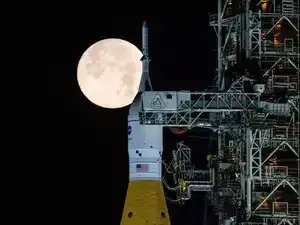
NASA halted a key test of its Artemis II mission rocket on Monday after engineers detected a fuel line leak during preparations at Kennedy Space Center. The pause came during a major rehearsal meant to ready the Space Launch System (SLS) rocket and the Orion spacecraft for a historic human flight around the moon, the first since 1972.
The goal is to check whether the Boeing-built SLS rocket and Lockheed Martin’s Orion spacecraft are fully prepared for a roughly 10-day mission that will take astronauts around the moon and back to Earth.
The space agency said teams are now working to identify and fix the problem but did not give a clear timeline for when the test will resume.
“The earliest opportunity to launch is February 8,” NASA said, adding that a final launch date will be announced only after the rehearsal is completed successfully.
Because of this limitation, the rehearsal focuses on fueling, countdown procedures, and system checks rather than engine firing.
Each Artemis launch is expected to cost more than $4 billion, and the program has seen budget overruns and schedule slips during its nearly 15 years of development.
Artemis is NASA’s flagship lunar programme, aimed at sending humans back to the moon for the first time since Apollo 17 in December 1972. Beyond landing astronauts, the plan includes building a sustained presence through projects like the Lunar Gateway, a space station intended to support future moon and Mars missions.
The mission will mainly test Orion’s life-support systems with astronauts on board, a critical step before Artemis III. That future mission is expected to attempt a crewed lunar landing by 2028.
Artemis I, launched in November 2022, successfully sent an uncrewed Orion capsule around the moon, proving the basic performance of the rocket and spacecraft. Artemis II is now set to take the next big leap, carrying humans into deep space once again.
What is the Artemis wet dress rehearsal?
NASA teams are carrying out what is known as a “wet dress rehearsal” for the Artemis rocket. During this process, engineers load ice-cold propellant into the rocket, run through a full launch countdown, and then safely drain the fuel. The exercise closely copies what will happen on the actual launch day.Budget 2026 Highlights: Here's the fine print
The goal is to check whether the Boeing-built SLS rocket and Lockheed Martin’s Orion spacecraft are fully prepared for a roughly 10-day mission that will take astronauts around the moon and back to Earth.
Why did NASA stop the Artemis rocket launch?
The rehearsal ran into trouble when sensors detected higher-than-allowed levels of liquid hydrogen leaking from a fuel line. NASA confirmed that engineers stopped the fueling process immediately to address the issue.The space agency said teams are now working to identify and fix the problem but did not give a clear timeline for when the test will resume.
“The earliest opportunity to launch is February 8,” NASA said, adding that a final launch date will be announced only after the rehearsal is completed successfully.
Why engines will not fire during the test
NASA has made it clear that the Artemis rocket’s engines will not ignite during this rehearsal. The design of the SLS rocket allows its powerful boosters to be fired only once, which makes a full engine test on the launch pad impossible.Because of this limitation, the rehearsal focuses on fueling, countdown procedures, and system checks rather than engine firing.
What is NASA’s Artemis II mission?
Artemis II will mark the second flight of the SLS rocket and Orion spacecraft, following the uncrewed Artemis I mission in 2022. That earlier mission also faced delays and required multiple wet dress rehearsals due to technical issues.Each Artemis launch is expected to cost more than $4 billion, and the program has seen budget overruns and schedule slips during its nearly 15 years of development.
Artemis is NASA’s flagship lunar programme, aimed at sending humans back to the moon for the first time since Apollo 17 in December 1972. Beyond landing astronauts, the plan includes building a sustained presence through projects like the Lunar Gateway, a space station intended to support future moon and Mars missions.
Who is flying on Artemis II?
The Artemis II crew includes Reid Wiseman, Victor Glover, Christina Koch, and Canadian Space Agency astronaut Jeremy Hansen. None of them are taking part in Monday’s rehearsal, as astronauts must remain in quarantine before launch-related activities.The mission will mainly test Orion’s life-support systems with astronauts on board, a critical step before Artemis III. That future mission is expected to attempt a crewed lunar landing by 2028.
Artemis I, launched in November 2022, successfully sent an uncrewed Orion capsule around the moon, proving the basic performance of the rocket and spacecraft. Artemis II is now set to take the next big leap, carrying humans into deep space once again.