Billionaire Elon Musk has predicted that within 36 months, or likely sooner, space will be the most economical location for artificial intelligence (AI) data centres, eclipsing Earth-based options due to vastly superior solar efficiency and the absence of a need for batteries.
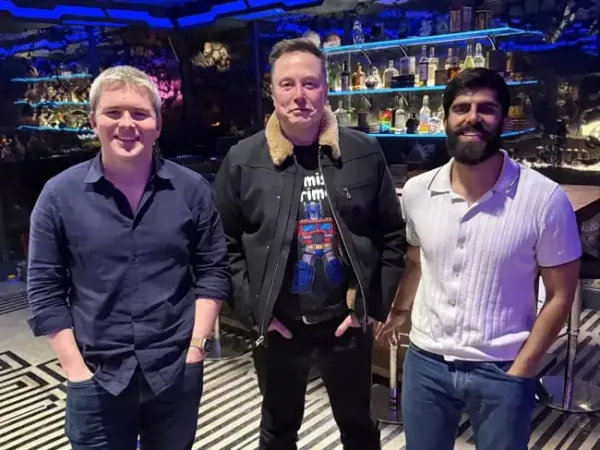
Talking on the Dwarkesh Podcast, co-hosted by Dwarkesh Patel and Stripe president John Collison, Musk said Earth has some insurmountable power bottlenecks in scaling AI. "The availability of energy is the issue," Musk said, noting global electricity output outside China remains "pretty close flat" while chip production surges.
Musk quipped that he meant to wear a t-shirt that said, "It's always sunny in space".
"Because you don’t have a day-night cycle, seasonality, clouds, or an atmosphere in space. The atmosphere alone results in about a 30% loss of energy [on Earth]," said Musk, adding, "It will simply not be physically possible to scale power production to the scale needed for AI on Earth."
"Any given solar panel can do about five times more power in space than on the ground. You also avoid the cost of having batteries to carry you through the night. It’s actually much cheaper to do in space," he said.
The billionaire, who is very close to a trillionaire status, said this days after his aerospace giant SpaceX acquired his AI company xAI, to create a $1.25 trillion behemoth. The company said it is acquiring xAI to “form the most ambitious, vertically-integrated innovation engine on (and off) Earth, with AI, rockets, space-based internet, direct-to-mobile device communications and the world’s foremost real-time information and free speech platform.”
On the podcast, Musk explained the multitude of issues facing the AI scaling problem.
For space to dominate economically, three conditions must come together, according to Musk:
If this happens, Musk said his ecosystem wins. SpaceX alone can launch at that cadence, powering xAI with unlimited gigawatts annually while rivals scrap over turbines and grids. "The only place you can really scale is space," he stressed, eyeing hundreds of gigawatts launched yearly via Starship.
Five years out, space AI could surpass all terrestrial capacity combined, lapping US power (500 GW average) repeatedly.
When asked about chances of technical issues of data centres in space, Musk said, "At this point, we find our GPUs to be quite reliable. There’s infant mortality, which you can obviously iron out on the ground. "Once they start working and you’re past the initial debug cycle, they’re quite reliable."
Talking on the Dwarkesh Podcast, co-hosted by Dwarkesh Patel and Stripe president John Collison, Musk said Earth has some insurmountable power bottlenecks in scaling AI. "The availability of energy is the issue," Musk said, noting global electricity output outside China remains "pretty close flat" while chip production surges.
Musk quipped that he meant to wear a t-shirt that said, "It's always sunny in space".
"Because you don’t have a day-night cycle, seasonality, clouds, or an atmosphere in space. The atmosphere alone results in about a 30% loss of energy [on Earth]," said Musk, adding, "It will simply not be physically possible to scale power production to the scale needed for AI on Earth."
"Any given solar panel can do about five times more power in space than on the ground. You also avoid the cost of having batteries to carry you through the night. It’s actually much cheaper to do in space," he said.
The billionaire, who is very close to a trillionaire status, said this days after his aerospace giant SpaceX acquired his AI company xAI, to create a $1.25 trillion behemoth. The company said it is acquiring xAI to “form the most ambitious, vertically-integrated innovation engine on (and off) Earth, with AI, rockets, space-based internet, direct-to-mobile device communications and the world’s foremost real-time information and free speech platform.”
On the podcast, Musk explained the multitude of issues facing the AI scaling problem.
For space to dominate economically, three conditions must come together, according to Musk:
- Earth's power hits a hard ceiling as AI demand explodes
- Chip fabs like Musk's planned "TeraFab" outpace energy scaling
- Starship achieve thousands of launches yearly.
If this happens, Musk said his ecosystem wins. SpaceX alone can launch at that cadence, powering xAI with unlimited gigawatts annually while rivals scrap over turbines and grids. "The only place you can really scale is space," he stressed, eyeing hundreds of gigawatts launched yearly via Starship.
Five years out, space AI could surpass all terrestrial capacity combined, lapping US power (500 GW average) repeatedly.
When asked about chances of technical issues of data centres in space, Musk said, "At this point, we find our GPUs to be quite reliable. There’s infant mortality, which you can obviously iron out on the ground. "Once they start working and you’re past the initial debug cycle, they’re quite reliable."