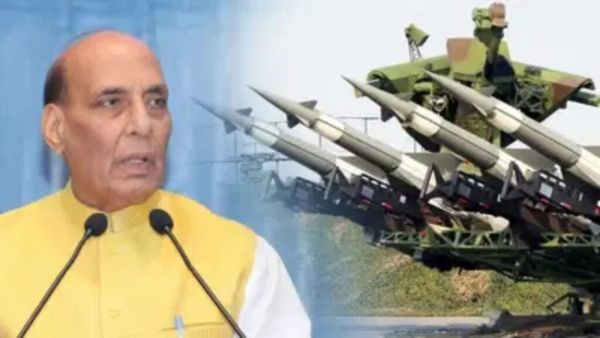
The Defense Ministry has taken an important step towards equipping the Indian Army with modern aerial surveillance capability. The Ministry has issued a Request for Proposal for the acquisition of 30 Improved Low-Level Light Weight Radar (LLLR-I) and 2 Classroom Variant Radar (CRV). The total estimated cost of this deal is said to be Rs 725 crore.
This procurement will be completed through fast track and emergency procurement process, so that this state-of-the-art technology can be made available to the Army as soon as possible. The radar system will be developed in such a way that it can be easily deployed in hilly areas, high altitude areas, plains, semi-desert areas, deserts and coastal areas.
Full integration with Akashteer systems
According to Defense Ministry documents, these radars will be fully integrated with the Indian Army’s Akashtir Command and Reporting System. The hardware and software required for this will already be included in these radars. Also, it will be mandatory to follow Army Cyber Group norms to ensure connectivity with the Army data network.
State-of-the-art radar equipped with 3D AESA technology
The RFP clarifies that LLLR-I will be an advanced air surveillance system based on 3-dimensional AESA (Active Electronically Scanned Array) technology. It will use modern GaN based modules and digital beam forming technology. The system will be able to identify, track and prioritize small aerial targets such as enemy aircraft, helicopters and drones as per threat level.
Specific capabilities of the radar include the ability to detect targets with 2 square meter RCS up to 50 km, small targets with 0.1 square meter RCS up to 18 km and extremely small targets such as drones with 0.001 RCS at close range. This feature is considered extremely important in dealing with drones and loitering munitions.
Simultaneous monitoring of hundreds of targets
This radar system will have the capability to track hundreds of air targets simultaneously. According to the RFP, the radar will be able to transmit information about at least 20 targets to 10 command posts or 10 weapon systems at a time. These systems will be able to operate up to a distance of 20 kilometers from the radar and connectivity will be established through line, radio or radio relay. If required, it can be expanded up to 20 target data receivers.
The radar system will include search radar, commander display unit (CDU), target designation system (TDS) and power supply unit. It will be specially designed for air defense of sensitive areas and important installations.
Lightweight and portable design
Keeping in mind the mobility of the system, the weight of the entire radar set (except power supply) will not exceed 175 kg. It can be easily transported by road, rail, plane or helicopter. It will be ready for operation within just 10 minutes of deployment.
The radar has been designed to operate effectively at altitudes up to 5,000 meters above sea level and in temperatures ranging from minus 20 degrees to 45 degrees Celsius. This facility will facilitate its deployment in border and sensitive areas.
Make in India promotion
Use of at least 60 percent indigenous material has been made mandatory in this procurement, which will give a big boost to the country’s defense industry. This initiative is an important step towards indigenization in the defense sector under the Self-reliant India campaign.
As per the delivery schedule, the first phase of 15 radars and 1 CRV is to be delivered within 12 months of advance payment, while the remaining radars will be delivered in the next 6 months. The minimum service life of the radar system has been fixed at 10 years and the companies will have to submit complete details to the reliability of the system.
The bidding company will have to provide a comprehensive training package for operators, trainers and maintenance personnel. Maintenance training will first need to be conducted 3 to 6 months before the warranty of the system expires. Defense experts believe that this acquisition will significantly strengthen the air defense surveillance capability of the Indian Army and further strengthen the security of the country’s borders.
-
How India can bring quality along with quantity in undergraduate science

-
Iran’s revolt, the return of monarchy, and a world that won’t listen

-
Reputation risk insurance: From image to financial shield for India Inc

-
Cries in the urban wilderness: Mental health issues need to be addressed individually and collectively

-
Protect personality by ensuring consent