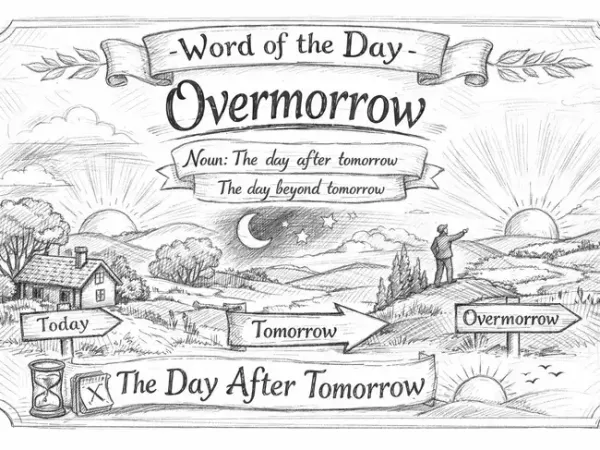
Overmorrow is a rare but useful English word that means the day after tomorrow. If today is Monday, the overmorrow is Wednesday. It gives a clear way to talk about near-future time without using longer phrases.
ORIGIN OF OVERMORROW
The word overmorrow comes from Old English. It is formed from 'over', meaning beyond, and 'morrow', meaning tomorrow. The earliest known use of the word overmorrow is in the mid 1500s. Similar words existed in other old Germanic languages, showing that early speakers liked precise words for time. Over the years, the word faded from everyday use as people began saying 'the day after tomorrow' instead.
USAGE OF OVERMORROW
Although overmorrow is not commonly used today, it still appears in poetry, historical writing, and modern word-of-the-day features. Writers and speakers may use it to sound more expressive, old-fashioned, or playful. It can also be useful in headlines or short messages where space is limited. The word is a noun and is usually used with articles like the or this.
EXAMPLES OF OVERMORROW
Learning words like overmorrow helps expand your vocabulary and makes your language more precise. While it may not replace common phrases in daily speech, it adds charm and clarity when used well. In a fast-moving world, having a single word for 'the day after tomorrow' can feel surprisingly helpful and memorable.
ORIGIN OF OVERMORROW
The word overmorrow comes from Old English. It is formed from 'over', meaning beyond, and 'morrow', meaning tomorrow. The earliest known use of the word overmorrow is in the mid 1500s. Similar words existed in other old Germanic languages, showing that early speakers liked precise words for time. Over the years, the word faded from everyday use as people began saying 'the day after tomorrow' instead.
USAGE OF OVERMORROW
Although overmorrow is not commonly used today, it still appears in poetry, historical writing, and modern word-of-the-day features. Writers and speakers may use it to sound more expressive, old-fashioned, or playful. It can also be useful in headlines or short messages where space is limited. The word is a noun and is usually used with articles like the or this.
EXAMPLES OF OVERMORROW
- The meeting is scheduled for the overmorrow, so we still have time to prepare.
- Rain is expected tomorrow, but the overmorrow should be sunny and clear.
- She promised to call today, visit tomorrow, and leave by the overmorrow.
- In old letters, people often used words like overmorrow to describe time.
Learning words like overmorrow helps expand your vocabulary and makes your language more precise. While it may not replace common phrases in daily speech, it adds charm and clarity when used well. In a fast-moving world, having a single word for 'the day after tomorrow' can feel surprisingly helpful and memorable.