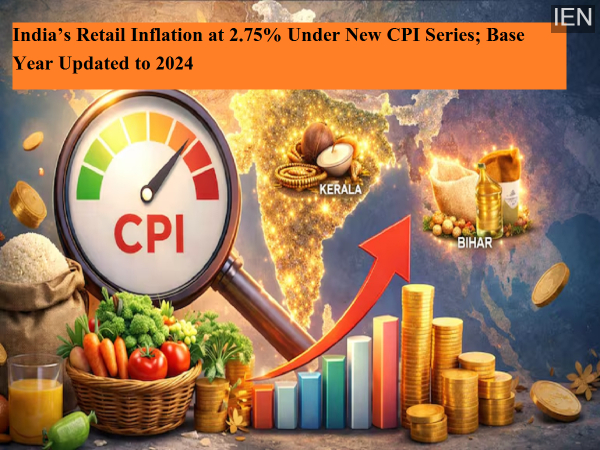
India’s retail inflation stood at 2.75% under the newly revised Consumer Price Index (CPI) series, marking a major methodological shift in how price trends are measured. The updated data, released on February 12, 2026, reflects changes introduced after more than a decade, including a new base year of 2024 instead of 2012, revised weightages, and an expanded basket of goods and services. Economists say these updates aim to better capture modern consumption patterns and evolving economic realities.
Major Overhaul After a Decade
The CPI revision represents one of the most significant statistical updates in recent years. Under the previous series, last month’s inflation was recorded at 1.33%, indicating that methodology changes can meaningfully alter headline figures. Analysts stress that such revisions are standard practice worldwide because consumption patterns shift over time due to urbanization, technology adoption, and rising incomes.
Data from the new series also shows that prices have been gradually rising over the past three months. The index value climbed from 104.01 in November to 104.10 in December, and further to 104.46 in January, suggesting a mild but steady upward trend in consumer prices.
Food’s Weight Falls Below 40% for the First Time
One of the most notable changes is the reduced importance of food in the CPI basket. The weight of food items has dropped to below 40%, while non-food categories now account for more than 60% of the index. Previously, non-food components represented roughly 45%.
This shift indicates that policymakers now recognize the growing role of services and discretionary spending in household budgets. It also reflects a structural change in India’s economy, where spending is no longer dominated by basic food consumption alone.
In addition, the revised CPI gives greater importance to rural consumption patterns, highlighting the rising influence of rural demand on overall economic activity.
Food Inflation and Category Trends
Under the new calculation method, food inflation came in at 2.13%. Within the food and beverages category—whose weight is now about 37%—inflation was recorded at 2.11%. Certain items saw sharp price increases, including tomatoes, which surged by nearly 64.8%, and coconut and coconut oil, both of which posted double-digit inflation rates.
Despite these spikes, the reduced weight of food means that short-term fluctuations in vegetable or grain prices will have a smaller impact on overall inflation than before.
Personal Care, Gold and Silver Drive Price Rise
The personal care category recorded inflation of 19.02%, driven largely by precious metal prices. Silver jewellery prices rose by around 160%, while gold prices increased roughly 47%, significantly raising household spending in this segment.
Other sectors showed moderate price increases:
-
Education services: 3.35% inflation
-
Restaurant and housing services: 2.87%, slightly above the national average
These figures highlight how services and lifestyle-related costs are becoming increasingly influential in determining overall inflation.
Expanded CPI Basket Reflects Modern Lifestyles
The revised CPI basket now includes more than 350 items, compared to 299 earlier, and price data is collected from a larger number of markets. Newly added items include wireless earphones, pet food, sanitizers, fitness bands, and air purifiers.
Officials say these additions are meant to reflect changing consumer preferences shaped by urban lifestyles, rising incomes, and post-pandemic health awareness. By including such products, the index aims to present a more realistic snapshot of actual household spending.
Weight Changes Across Key Categories
Several sectors saw increases in their CPI weight:
-
Housing, water, electricity, gas, and fuel: up from 16.9% to 17.7%
-
Healthcare: up from 5.9% to 6.1%
-
Transport and communication: up from 8.6% to 12.4%
The sharp rise in transport and communication weight reflects growing mobility, digital connectivity, and higher usage of modern services across both urban and rural regions.
What the New Method Means for Inflation Readings
With the revised series, headline inflation will be less sensitive to sudden spikes in food prices and more influenced by trends in services, housing costs, and discretionary spending. This change is expected to give policymakers a clearer picture of underlying inflationary pressures rather than short-term volatility.
In practical terms, inflation data will now better represent how Indians actually spend money today—factoring in lifestyle upgrades, technology adoption, and shifting consumption habits.
Conclusion
The introduction of the new CPI series with a 2024 base year marks a significant modernization of India’s inflation measurement system. While the latest reading of 2.75% suggests moderate price growth, the real significance lies in the methodology overhaul. By reducing food’s dominance, expanding the basket of goods, and increasing the weight of services, the updated index offers a more accurate and contemporary view of inflation—one that aligns closely with the realities of a rapidly changing economy.
-
Rafale, SCALP get DAC nod; Meteor missile next? How India is planning to make 'Op Sindoor hero' a mighty fighter

-
Nurse who recovered from Nipah virus infection dies of cardiac arrest in Bengal hospital: Official

-
Manipur: Tear gas fired as protest erupts outside Churachandpur MLA’s home

-
Infosys to deploy ExxonMobil’s data centre fluids for efficient cooling of AI infra

-
VCs break taboo by backing both Anthropic, OpenAI in AI battle