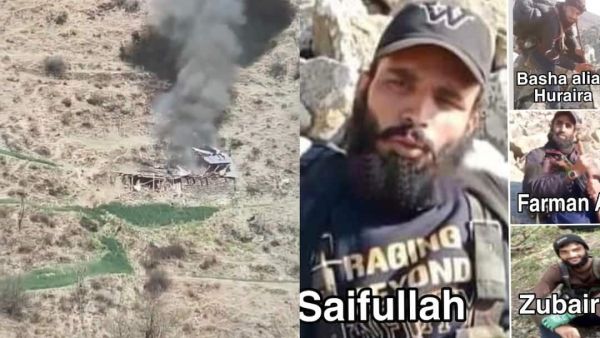
In a sustained 30-day counter-terrorism campaign, Indian security forces, working closely with the Intelligence Bureau, have dismantled one of the oldest and most dangerous operational modules of the Pakistan-based terror group Jaish-e-Mohammed in the Jammu division of Jammu and Kashmir. The operation culminated in the killing of three senior operatives in the Trashi area of Kishtwar, effectively neutralising the core of a network that had remained active across Udhampur, Kathua, Doda and Kishtwar for nearly three years. Officials described the offensive as one of the most coordinated and strategically executed operations in the region in recent years.
Final Strike In Trashi
The decisive encounter unfolded in the forested Trashi belt of Kishtwar, where security forces eliminated Saifullah Baloch, identified as a senior Jaish commander, along with Pakistani nationals Farmaan Ali and Basha, also known as Huraira. Each of the three had a bounty of Rs 5 lakh declared last year by Kishtwar Police.
The operation was launched after the Intelligence Bureau received specific inputs regarding the terrorists' precise location. Acting swiftly, joint teams of the Indian Army, the Central Reserve Police Force and the Jammu and Kashmir Police cordoned off a wooden structure in Trashi at around 11am. To confirm the presence of militants inside, the Army deployed a trained sniffer dog named Tyson. As the dog approached the structure, gunfire erupted from within, confirming the militants’ presence.
Security forces escalated the operation, eventually using a rocket launcher to destroy the structure. After nearly an hour of intermittent firing and no further response from inside, personnel moved in to clear the site. The charred bodies of Saifullah Baloch and Basha were recovered from the debris, with Saifullah’s face still identifiable despite extensive damage. A third body, later confirmed to be Farmaan Ali, was found during further clearance of the rubble. No security personnel were injured during the encounter.
A Month-Long Campaign
The Trashi encounter marked the culmination of a broader offensive that intensified in late December 2025. On January 23, security forces killed Zubair Ali, a Jaish operative from Multan, in Billawar. On February 4, two more key operatives, Usman Akhtar, also known as Nikku, from Jammu and Kashmir, and Lukman Bashir, alias Abu Mavia, from Pakistan’s Zafarwal, were eliminated in the forests of Jopher in Udhampur’s Basantgarh sector.
Later the same day, Swaruddin, also known as Adil Khan, a Rs 5 lakh bounty militant from Kohat in Khyber Pakhtunkhwa, was killed in a separate encounter in Trashi. During that earlier exchange, Saifullah and his associates managed to escape, only to be tracked down and eliminated in the latest operation.
Intelligence assessments suggest that this Jaish module was restructured following the 2019 Indian airstrike on the Balakot training facility during Operation Bandar. After the destruction of the Madarsa Taleem-ul-Quran complex in Balakot, Jaish reportedly shifted its primary training infrastructure to the Hangu region of Khyber Pakhtunkhwa near the Samana Ranges. Approximately 31 terrorists were trained there before infiltrating Jammu in 2023 in five separate groups, allegedly with logistical backing from Pakistan’s Inter-Services Intelligence and an operative identified as Qasim Lala.
Once inside Indian territory, the infiltrators initially operated in the Doda-Kishtwar belt before reorganising into four operational units. Saifullah headed one group, Usman Akhtar led another, Ruksar, alias Maulvi, commanded a third, and Lukman Bashir led the fourth. Intelligence sources believe overall coordination was handled by Wali Hassan, an adopted son of Jaish chief Masood Azhar, who is believed to remain active in Jammu and Kashmir.
The module was linked to several attacks, including a July 2024 ambush on an Army convoy in Doda in which four soldiers, including Captain Brijesh Thapa, were killed. The attackers reportedly desecrated the officer’s body and circulated video footage of the mutilation through proxy accounts linked to the group.
Strategy & Aftermath
Learning from earlier engagements, security agencies recalibrated their strategy. The Intelligence Bureau and Jammu and Kashmir Police gathered precise, ground-verified intelligence on the movements and hideouts of the Jaish operatives. After corroborating the information through multiple sources, the inputs were forwarded to the Army’s 16 Corps for operational planning.
Simultaneous operations were launched to isolate key operational zones and disrupt support networks. Internet services were suspended in Kishtwar from January 20 to restrict communication and prevent coordination among terrorists. Coordinated strikes across Kathua, Udhampur and Kishtwar ensured that no regrouping or reinforcement could take place.
With the elimination of Saifullah, Farmaan Ali, Basha, Adil Khan, Zubair Ali, Usman Akhtar and Lukman Bashir within a span of 30 days, the operational backbone of Jaish-e-Mohammed in the Jammu division has been largely dismantled. However, intelligence sources indicate that Wali Hassan remains active, along with a long-serving Jaish operative known as Bijli Bhai, alias Sadiq, who is believed to oversee an Over Ground Worker network in parts of Kashmir with a small group of terrorists.
Officials describe the month-long offensive as a significant setback for Jaish-e-Mohammed’s presence in the Doda, Kishtwar, Kathua and Udhampur region, marking a major operational gain for Indian security forces in Jammu.
-
UAE to rescue over 300,000 tonnes of surplus food for family iftar boxes this Ramadan
-
Martin Lewis MSE issues 30-day warning to Sky TV and broadband customers

-
Yogi Adityanath Secures Rs 6,650-Crore Investment for Uttar Pradesh in Singapore
-
SC tells Lucknow election officer to probe exclusion of 91 displaced persons from voter rolls
-
Households encouraged to follow 4-minute EDF Energy rule to save £60 on energy bills