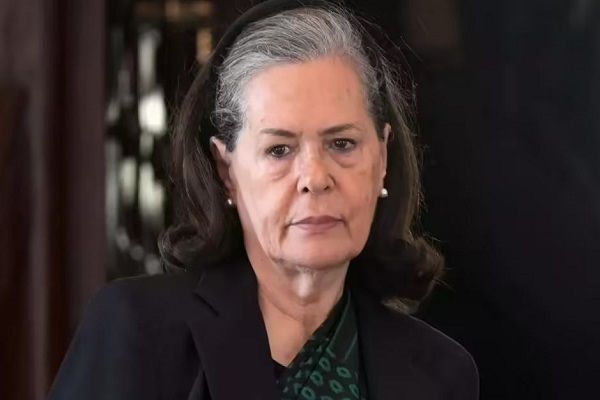
New Delhi, March 3. Congress Parliamentary Party (CPP) President Sonia Gandhi has criticized the central government’s silence on the assassination of Iran’s Supreme Leader Ayatollah Ali Khamenei during joint air strikes by the US and Israel. He said that not giving any official statement on this matter is not neutrality, but it is tantamount to shirking responsibility. He said the Indian government has refrained from condemning the violation of Iran’s sovereignty or the killing.
Referring to Prime Minister Narendra Modi’s recent comments on the West Asia conflict, he said that initially the Prime Minister limited himself to condemning Iran’s retaliatory attack on the UAE, ignoring the horrific attack by the US and Israel, and did not comment on the events preceding that. Later, they made empty statements expressing their ‘deep concern’ and talked about ‘dialogue and diplomacy’, while the same process was underway just before these horrific and unprovoked attacks by Israel and the US.
He further said that when our country makes no clear defense of sovereignty or international law and abandons impartiality when a targeted assassination of a foreign leader takes place, it raises serious questions about the direction and credibility of our foreign policy. Sonia Gandhi said that the assassination was carried out without a formal declaration of war and during the ongoing diplomatic process. He said Article 2(4) of the UN Charter prohibits the threat or use of force against the territorial integrity or political independence of any State. He said the targeted killing of a serving head of state attacks these principles.
The Congress Rajya Sabha member criticized the Prime Minister for his apparent support of the Benjamin Netanyahu-led Israeli government, citing the Gaza conflict, and said India’s high-level political support without moral clarity represents a clear and worrying deviation. Reiterating Congress’s stand on the assassination of the Iranian supreme leader, he described the act as a dangerous step with serious consequences at the regional and global levels.
Sonia Gandhi also reminded that in 1994, when some factions of the Organization of Islamic Cooperation were bringing a resolution against India in the United Nations Human Rights Commission on the Kashmir issue, Iran had made great efforts to stop that effort. He also noted that Iran has made possible India’s diplomatic presence in Zahedan near the Pakistan border, which is considered a strategic counterbalance to the development of Gwadar port and the China-Pakistan Economic Corridor. He also recalled that in 2001, then Prime Minister Atal Bihari Vajpayee had visited Tehran and reaffirmed deep ties with Iran.
He said that in recent years, India’s relations with Israel have expanded into defence, agriculture and technology sectors. India has diplomatic leeway to urge restraint because of its relations with both Tehran and Tel Aviv. But this scope depends on reliability. Credibility, in turn, rests on the perception that India speaks on the basis of principles, not self-interest. Expressing concern over attacks on Indian citizens in the Gulf countries, Gandhi said India’s ability to protect its citizens is based on its credibility as an independent actor and not as a proxy.
-
Gold Prices Fall for Third Straight Day Despite US-Iran Tensions; Check Latest Rates in 10 Major Cities

-
Holi 2026: Create Stunning Festive Greetings Using ChatGPT, Grok, Gemini and Other AI Tools

-
EMI Planning in 2026: 3 Smart Tests to Take Before Applying for Any Loan

-
India Enforces SIM-Link Rule for Messaging Apps; Accounts May Stop Working Without Active Registered SIM

-
Holi 2026 Alert: Rising Online Scams Target Users With Fake Jobs, Rental Deals and Loan Apps