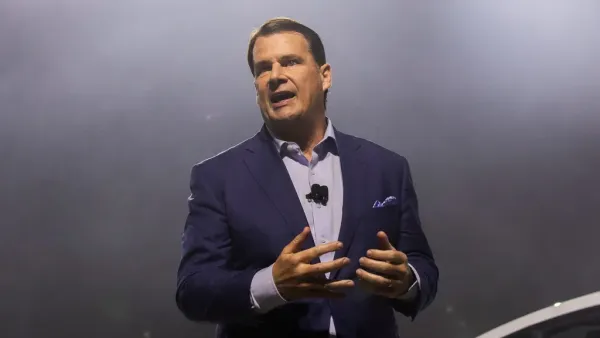
As manual transmissions continue disappearing across the automotive industry, Ford is taking a very different stance. The company’s CEO, Jim Farley, has made it clear that the iconic three-pedal setup in the Ford Mustang is here to stay.
Speaking to media during the 2026 Australian Grand PrixFarley delivered an emphatic message about the future of the manual Mustang.
“Out of our cold, dead hands will we not have a manual Mustang,” he said in an interview, making Ford’s position unmistakably clear.
The comment comes at a time when many performance cars have abandoned manual gearboxes in favor of faster, more efficient automatic transmissions. But Ford believes driver engagement still matters, and the Mustang remains one of the few mainstream performance cars where enthusiasts can still row their own gears.
Manual Still Alive in the V-8 Mustang
Ford’s latest generation Mustang offers several performance variants, and not all of them include a manual transmission. The ultra-high-performance Mustang GTD and the newly introduced Dark Horse SC both rely exclusively on automatic gearboxes to handle their massive power outputs.
However, Farley’s comments reinforce that the manual gearbox will remain available in core V-8 models, including the Mustang GT and the standard Dark Horse.
Ford has already made one adjustment to its lineup. The manual transmission option was removed from the four-cylinder EcoBoost Mustang with the current generation, largely due to limited customer demand. Enthusiasts buying V-8 Mustangs, however, continue to show strong interest in manual transmissions.
While Ford hasn’t publicly disclosed exact take-rate figures, demand appears healthy enough to justify keeping the three-pedal setup alive.
An Industry Moving Away from Manuals
Ford’s commitment stands out in an industry that has largely moved on from manual gearboxes. Automakers are increasingly prioritizing automatic and dual-clutch transmissions that deliver faster acceleration, improved fuel efficiency, and compatibility with modern driver-assistance technologies.
In recent years, several performance models have dropped manual options entirely. Mini has phased out manual transmissions in many markets, while Volkswagen has discontinued them in the latest GTI and Golf R. Even enthusiast-focused vehicles are gradually moving away from stick shifts.
The trend is expected to accelerate as electrification spreads across the automotive landscape. Electric vehicles do not require traditional multi-speed gearboxes, making manual transmissions largely incompatible with future EV architectures.
A Cultural Symbol for Enthusiasts
Farley’s passionate defense of the manual Mustang reflects more than just a product decision. For many enthusiasts, driving a manual transmission represents a deeper connection between driver and machine.
The act of shifting gears manually, balancing the clutch, and controlling engine power creates a level of engagement that automated systems cannot replicate.
The Mustang has long been a symbol of that connection. Since its introduction in 1964, the car has been closely associated with driver-focused performance and accessible muscle car thrills.
By keeping the manual alive, Ford is preserving an element of automotive culture that many enthusiasts fear could soon disappear.
The Road Ahead
Despite the broader industry shift toward electrification and automation, Ford’s leadership appears committed to keeping the manual Mustang alive for as long as possible.
For drivers who still believe performance should involve three pedals and a gear lever, that promise is welcome news.
And if Farley’s words are any indication, the manual Mustang isn’t going down without a fight.
-
Complete ration card details are now available on your phone; learn how to check shop and ration information.
-
Many trains in this state will be cancelled in March and April; check the full list before traveling.
-
The 22nd installment will be credited to these farmers' accounts on March 13th, leaving them empty-handed. Learn the latest updates.

-
The government has opened the 8th Pay Commission portal; learn how to register.

-
If you're traveling with a group or family, read these rules immediately; the Railways has made a significant change.