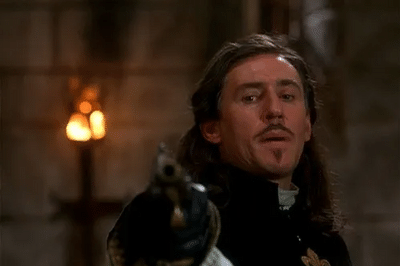
A centuries-old mystery may have been solved after archaeologists in the Netherlands uncovered human remains that could belong to the real-life musketeer who inspired the famous d’Artagnan.
The skeleton was found beneath the floor of the Church of St Peter and St Paul in Maastricht’s Wolder district - a high-status burial site long associated with the elite - and early clues are electrifying historians and literature lovers.
A French coin dated 1660 was recovered alongside the remains, firmly placing the burial in the correct era, while a battlefield wound matches the legend.
- Euthanasia gang rape victim's friend turned away in heartbreaking moment
- Daredevil skydiver plunges to death while testing new parachute
Investigators found a fragment of a musket ball lodged at chest or throat level that matches records that Charles de Batz de Castelmore, better known as d’Artagnan, died by gunfire during the 1673 Siege of Maastricht.
The church floor burial aligns with the status one would expect for a high-ranking officer serving under the Sun King, Louis XIV.
Hunt for Earth 2.0, Africa's 'King Arthur' was real, robots serve Big Macs, and should you shoot Bigfoot if you see him? All this and more in our latest weird science newsletter
Deacon Jos Valke, who is overseeing the excavation, told the BBC that he’s "almost certain" they've found the famed soldier, noting that the convergence of the location, artefacts, and injury pattern is unusually compelling.
"We became quite silent when we found the first bone," he said. "He was buried on sacred ground below where the altar was; we found the bullet that put an end to his life, and we found a coin from 1660 in his grave, and it was from the bishop who attended Mass for the Roi Soleil."
DNA samples have now been sent to Munich for comparison with known descendants of d’Artagnan’s family in the hope a genetic match will offer conclusive proof.
Dumas' d’Artagnan is one of literature’s most enduring heroes - swaggering through shelves, stages and screens for generations. To link that legend to a tangible set of remains would fuse pop culture with primary history in a way few discoveries can.
French author Alexandre Dumas brought him to life in 19th Century novel The Three Musketeers and its sequels.
Although d'Artagnan was modelled on a historical figure, the three musketeers themselves were fictional characters who may have been inspired by three members of an elite corps that protected the king and took part in military action.
-
Arrival at departure lounge: Building a transit hub faces challenges deeper than the infra build-up Noida airport represents

-
Rupee's steep fall: Are India's macro fundamentals strong enough to withstand global shocks?

-
Consent creation in client service calls

-
Trump's Believability Index is Critically Low

-
Crusoe to build 900-megawatt AI data center for Microsoft in Texas