
New Delhi: The finance ministry has directed public sector banks (PSBs) to explore quantum-resistant encryption as an added security layer under this year's innovation and security initiatives, people aware of the matter told ET.
Experts warn that quantum computing could become so powerful over the next few years that it will be able to break the most sophisticated of encrypted systems within seconds.
According to industry estimates, India's banking and telecom sectors may need to spend up to ₹2,000 crore each over the next five to seven years to upgrade their cybersecurity and computing infrastructure and make them quantum-ready.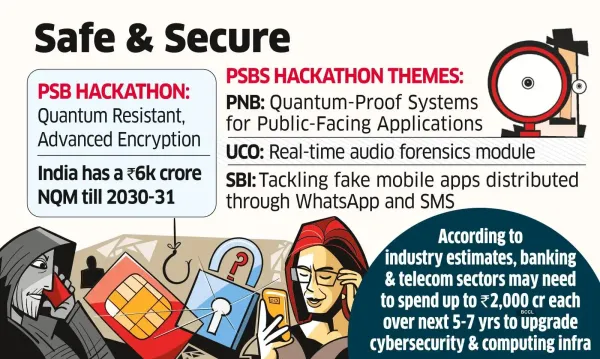 The hackathon theme to be pursued by PSBs in 2026 will be "Cybersecurity and Fraud" and is part of the government's 'Aatmanirbhar Bharat' push in cybersecurity, the people cited earlier said.
India has set aside ₹6,000 crore for its National Quantum Mission (NQM), which will aim to build a 2,000-km quantum communication network by 2030-31.
A report by Citi Bank puts the loss to the US economy at up to $3.3 trillion in indirect impact at just one of the large banks.
Regulators in the US, Europe and the G7 want banks to start tightening security of their computing infrastructure now, with many targeting critical systems by 2030 and full migration by 2035. Globally, large lenders such as JPMorgan Chase, Goldman Sachs, Barclays, HSBC and payment firms like Mastercard are already testing quantum-safe encryption to protect customer data and payments.
Quantum-resistant encryption can help banks protect customer records, payments, ATM networks, mobile apps and inter-bank communication.
Punjab National Bank is pursuing "Quantum-Proof Systems for Public-Facing Applications" in 2026 to safeguard its digital financial infrastructure against the risks posed by quantum computing.
Kolkata-based UCO Bank is looking to develop a real-time, audio forensics module that analyses the spectrogram of a live call to detect fraudsters cloning a customer's voice by capturing just a few seconds of audio and bypassing voice biometric passwords or fooling call-centre agents into transferring funds.
State Bank of India, the country's largest lender, is partnering with the Indian Institute of Technology, Jodhpur, on tackling fake mobile apps distributed through WhatsApp and SMS that lead to phishing and financial fraud.
According to Subimal Bhattacharjee, a tech policy analyst and cybersecurity expert, the challenge is that banks cannot replace this overnight because vulnerable encryption is buried across apps, cards, payment systems, ATMs, cloud networks and data centres. "Banks will first need to identify where these systems sit before moving to new standards," he said.
Ajai Chowdhry, chairman, EPIC Foundation and Mission Governing Board, National Quantum Mission, said "Q-Day" is now looking like 2029 and the NQM has created a plan for organisations to become quantum-secure. "The National Quantum Mission has set up a task force with a migration roadmap," he said.
In January, financial services secretary M Nagaraju had said the government is concerned about rising frauds. "Traditional systems have been deployed to tackle these issues, but extensive deliberation is required to find feasible solutions, where the role of AI and GenAI will be very vital."
Experts warn that quantum computing could become so powerful over the next few years that it will be able to break the most sophisticated of encrypted systems within seconds.
According to industry estimates, India's banking and telecom sectors may need to spend up to ₹2,000 crore each over the next five to seven years to upgrade their cybersecurity and computing infrastructure and make them quantum-ready.
India has set aside ₹6,000 crore for its National Quantum Mission (NQM), which will aim to build a 2,000-km quantum communication network by 2030-31.
A report by Citi Bank puts the loss to the US economy at up to $3.3 trillion in indirect impact at just one of the large banks.
Regulators in the US, Europe and the G7 want banks to start tightening security of their computing infrastructure now, with many targeting critical systems by 2030 and full migration by 2035. Globally, large lenders such as JPMorgan Chase, Goldman Sachs, Barclays, HSBC and payment firms like Mastercard are already testing quantum-safe encryption to protect customer data and payments.
Quantum-resistant encryption can help banks protect customer records, payments, ATM networks, mobile apps and inter-bank communication.
Punjab National Bank is pursuing "Quantum-Proof Systems for Public-Facing Applications" in 2026 to safeguard its digital financial infrastructure against the risks posed by quantum computing.
Kolkata-based UCO Bank is looking to develop a real-time, audio forensics module that analyses the spectrogram of a live call to detect fraudsters cloning a customer's voice by capturing just a few seconds of audio and bypassing voice biometric passwords or fooling call-centre agents into transferring funds.
State Bank of India, the country's largest lender, is partnering with the Indian Institute of Technology, Jodhpur, on tackling fake mobile apps distributed through WhatsApp and SMS that lead to phishing and financial fraud.
According to Subimal Bhattacharjee, a tech policy analyst and cybersecurity expert, the challenge is that banks cannot replace this overnight because vulnerable encryption is buried across apps, cards, payment systems, ATMs, cloud networks and data centres. "Banks will first need to identify where these systems sit before moving to new standards," he said.
Ajai Chowdhry, chairman, EPIC Foundation and Mission Governing Board, National Quantum Mission, said "Q-Day" is now looking like 2029 and the NQM has created a plan for organisations to become quantum-secure. "The National Quantum Mission has set up a task force with a migration roadmap," he said.
In January, financial services secretary M Nagaraju had said the government is concerned about rising frauds. "Traditional systems have been deployed to tackle these issues, but extensive deliberation is required to find feasible solutions, where the role of AI and GenAI will be very vital."