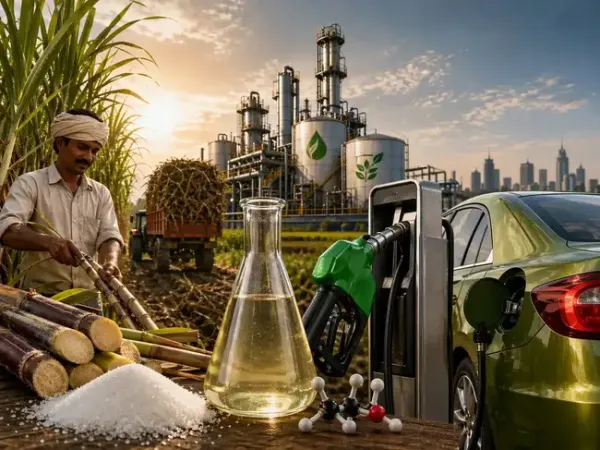
India’s ethanol strategy is, quite literally, rooted in sugar. What was once a policy aimed at managing surplus sugarcane and supporting farmer incomes is now being recast as a central pillar of energy security. The “sweet” promise of ethanol lies in its dual appeal -- it can reduce crude oil imports while putting more money in the hands of farmers. With global oil markets roiled by geopolitical tensions, this sugar-based fuel is gaining urgency as a domestic alternative. The question is no longer whether India should expand ethanol use, but how far and how fast it can go.
Also Read: India should aim for 100% ethanol blending, says Nitin Gadkari
Recent days have seen a flurry of policy and industry developments. Road transport minister Nitin Gadkari has called for moving towards 100 per cent ethanol blending, arguing that geopolitical disruptions have highlighted the need to cut crude dependence. The government is preparing fresh norms for vehicles capable of running on E85 to E100 fuels, reviving a lapsed notification to enable flex-fuel vehicles and pushing automakers towards commercial production. This comes after India made E20 petrol the nationwide standard from April 1. Social media has witnessed hot debates on the impact of ethanol-blended fuel on engine performance and longevity.
Authorities have also allowed ethanol and synthetic hydrocarbons to be blended in aviation turbine fuel, widening the scope of biofuels beyond road transport. On the supply side, policymakers were reportedly weighing curbs on sugar exports to divert surplus towards ethanol, even as sugar production has risen about 9 per cent to over 272 lakh tonnes till March-end. At the same time, reforms to the decades-old sugarcane law have been proposed, while the industry shows readiness to supply more than 20 per cent blending. This flurry of developments reflects a coordinated push across agriculture, energy and transport to deepen ethanol adoption.
India imports roughly 85 per cent of its crude oil needs, leaving it exposed to price shocks. According to CareEdge Global, every 10 per cent rise in crude prices can add about 60 basis points to inflation, underlining the macroeconomic vulnerability. Ethanol blending directly offsets a portion of this import bill. Industry estimates suggest that scaling blending beyond 20 per cent could significantly cut foreign exchange outflows on oil.
The West Asia crisis has sharpened this urgency. Disruptions in oil supply chains have already nudged policymakers and consumers towards alternatives. Ethanol, being domestically produced, offers a hedge against both price volatility and geopolitical risk.
Also Read: Govt eyes ethanol blend beyond 20%, pushes flex-fuel vehicles
India’s transition from E10 to E20 was relatively swift, culminating in nationwide availability last year. Moving beyond E20, however, requires a structural shift in vehicle technology. Flex-fuel vehicles, capable of running on anything from E20 to E100, are central to this next phase. While prototypes exist, large-scale commercial rollout is still pending. The upcoming notification on E85 and above fuels is expected to remove regulatory uncertainty and push original equipment manufacturers to scale production. Engines designed for E100 can also operate on lower blends, offering flexibility during the transition.
However, concerns persist. Earlier debates around ethanol-blended fuels highlighted potential issues such as reduced mileage and higher maintenance. These factors could influence consumer acceptance unless offset by price incentives or technological improvements.
Also Read: India allows ethanol blending in aviation fuel
Ethanol production in India is closely tied to sugarcane. The country’s sugar output has been robust, rising about 9 per cent year-on-year to 272.31 lakh tonnes by March 31, according to industry data. This has created room for diversion of excess sugar towards ethanol production. Policy discussions around capping sugar exports reflect this balancing act. Diverting surplus to ethanol helps stabilise domestic sugar prices while supporting biofuel output. At the same time, the government has maintained flexibility on export policies, indicating a measured approach rather than outright restrictions.
Yet, this linkage also creates tension. Ratings agency Ind-Ra has flagged that tight sugar inventories and fluctuating ethanol earnings could keep sugar prices firm, suggesting that the twin goals of affordable sugar and abundant ethanol may not always align.
India’s ethanol industry has seen rapid capacity expansion, with investments estimated at around Rs 50,000 crore. However, this growth has outpaced current demand, especially with the blending cap at 20 per cent. Reports of an ethanol glut highlight the risk of underutilised capacity if policy does not keep pace. Industry bodies have argued that they are ready to supply more than 20 per cent blending, and have called for quicker policy movement towards higher blends. An industry representative told ET that the sector is prepared for the next phase, but requires clear demand signals.
This mismatch between capacity and policy ceiling is a key reason behind the renewed push for E85 and E100 adoption.
Brazil’s ethanol programme is often cited as the gold standard, but its success rests on decades of consistent policy, infrastructure investment and consumer adaptation. The country not only allows high ethanol blends but has normalised them. Flex-fuel vehicles dominate its automobile market, and consumers routinely choose between gasoline and ethanol depending on price.
A key advantage for Brazil is cost competitiveness. Ethanol derived from sugarcane is often cheaper than gasoline, which encourages voluntary adoption rather than regulatory compulsion. Ethanol has helped stabilise fuel prices in Brazil by providing a readily available substitute when global oil prices spike.
For India, the lesson is less about replication and more about sequencing. Brazil built its ecosystem over decades, ensuring alignment between farmers, fuel producers, automakers and consumers. India, by contrast, is attempting to compress this transition into a much shorter timeframe. This raises risks of supply bottlenecks, pricing distortions, and consumer resistance if the ecosystem does not evolve in tandem.
The government’s move to overhaul a six-decade-old sugarcane law is central to aligning agriculture with energy goals. The existing regulatory framework has long governed how sugarcane is priced, procured and supplied to mills, often with heavy state intervention and rigid pricing formulas.
Reform aims to introduce greater efficiency and flexibility into this system. One objective is to better link sugarcane prices with market realities, including ethanol demand, rather than relying predominantly on administered prices. This could improve the financial health of sugar mills, many of which face cyclical stress due to mismatches between cane prices and sugar realisations.
Another goal is to create stronger incentives for farmers. By ensuring timely payments and offering alternative revenue streams through ethanol production, policymakers hope to make sugarcane cultivation more sustainable and attractive. Gadkari has emphasised that farmers could evolve into energy providers, supplying feedstock for fuel rather than just food markets.
At the same time, reforms are expected to rationalise the allocation of sugarcane between sugar and ethanol, allowing mills to respond dynamically to market conditions. This flexibility is crucial if ethanol is to scale without causing volatility in sugar supplies or prices.
The government's decision to allow ethanol blending in aviation turbine fuel (ATF) points to an ambition to extend biofuels beyond the relatively easier domain of road transport. Aviation accounts for a smaller share of fuel consumption but is far more difficult to decarbonise due to stringent performance requirements and limited alternatives.
Even partial substitution with ethanol-based or synthetic blends could reduce emissions and import dependence over time. However, the technological and regulatory challenges here are far more complex, involving safety certifications, engine compatibility and global aviation standards.
Beyond aviation, ethanol is being positioned as a multi-sector fuel. Its use in cooking, industrial processes and power generation reflects a broader strategy to integrate biofuels across the energy system. The ethanol push now spans stoves to cars to planes, indicating a whole-of-economy approach rather than a transport-only solution.
This diversification is important because it creates multiple demand channels, reducing the risk of oversupply and improving the economics of ethanol production.
Egged on by the Iran war, India’s ethanol journey is entering a decisive phase as is evident from a recent flurry of developments. The move from E20 to potentially E100 will be a systemic transformation which will require synchronised progress in vehicle manufacturing, fuel distribution, agricultural policy and consumer behaviour.
The risks are real. Excessive reliance on sugarcane, a water-intensive crop, could strain water resources and distort cropping patterns, as flagged by the latest Economic Survey. Price distortions could emerge if ethanol is not competitive with petrol. And consumer acceptance will hinge on both cost and convenience.
Yet, the opportunity is equally significant. A successful ethanol programme could reduce India’s oil import bill, stabilise inflation, support rural incomes and lower emissions. It could also position the country as a global leader in biofuels, particularly if it manages to scale sustainably. Ultimately, the “sweet” deal India is pursuing is a delicate balancing act between food and fuel, farmers and consumers, and economics and ecology. Getting that balance right will determine whether ethanol becomes a bridge to energy security or a detour with unintended consequences.
Also Read: India should aim for 100% ethanol blending, says Nitin Gadkari
Recent days have seen a flurry of policy and industry developments. Road transport minister Nitin Gadkari has called for moving towards 100 per cent ethanol blending, arguing that geopolitical disruptions have highlighted the need to cut crude dependence. The government is preparing fresh norms for vehicles capable of running on E85 to E100 fuels, reviving a lapsed notification to enable flex-fuel vehicles and pushing automakers towards commercial production. This comes after India made E20 petrol the nationwide standard from April 1. Social media has witnessed hot debates on the impact of ethanol-blended fuel on engine performance and longevity.
Authorities have also allowed ethanol and synthetic hydrocarbons to be blended in aviation turbine fuel, widening the scope of biofuels beyond road transport. On the supply side, policymakers were reportedly weighing curbs on sugar exports to divert surplus towards ethanol, even as sugar production has risen about 9 per cent to over 272 lakh tonnes till March-end. At the same time, reforms to the decades-old sugarcane law have been proposed, while the industry shows readiness to supply more than 20 per cent blending. This flurry of developments reflects a coordinated push across agriculture, energy and transport to deepen ethanol adoption.
The fix India needs
India imports roughly 85 per cent of its crude oil needs, leaving it exposed to price shocks. According to CareEdge Global, every 10 per cent rise in crude prices can add about 60 basis points to inflation, underlining the macroeconomic vulnerability. Ethanol blending directly offsets a portion of this import bill. Industry estimates suggest that scaling blending beyond 20 per cent could significantly cut foreign exchange outflows on oil.
The West Asia crisis has sharpened this urgency. Disruptions in oil supply chains have already nudged policymakers and consumers towards alternatives. Ethanol, being domestically produced, offers a hedge against both price volatility and geopolitical risk.
Also Read: Govt eyes ethanol blend beyond 20%, pushes flex-fuel vehicles
From E20 to E100
India’s transition from E10 to E20 was relatively swift, culminating in nationwide availability last year. Moving beyond E20, however, requires a structural shift in vehicle technology. Flex-fuel vehicles, capable of running on anything from E20 to E100, are central to this next phase. While prototypes exist, large-scale commercial rollout is still pending. The upcoming notification on E85 and above fuels is expected to remove regulatory uncertainty and push original equipment manufacturers to scale production. Engines designed for E100 can also operate on lower blends, offering flexibility during the transition.
However, concerns persist. Earlier debates around ethanol-blended fuels highlighted potential issues such as reduced mileage and higher maintenance. These factors could influence consumer acceptance unless offset by price incentives or technological improvements.
Also Read: India allows ethanol blending in aviation fuel
The sugar rush
Ethanol production in India is closely tied to sugarcane. The country’s sugar output has been robust, rising about 9 per cent year-on-year to 272.31 lakh tonnes by March 31, according to industry data. This has created room for diversion of excess sugar towards ethanol production. Policy discussions around capping sugar exports reflect this balancing act. Diverting surplus to ethanol helps stabilise domestic sugar prices while supporting biofuel output. At the same time, the government has maintained flexibility on export policies, indicating a measured approach rather than outright restrictions.
Yet, this linkage also creates tension. Ratings agency Ind-Ra has flagged that tight sugar inventories and fluctuating ethanol earnings could keep sugar prices firm, suggesting that the twin goals of affordable sugar and abundant ethanol may not always align.
India’s ethanol industry has seen rapid capacity expansion, with investments estimated at around Rs 50,000 crore. However, this growth has outpaced current demand, especially with the blending cap at 20 per cent. Reports of an ethanol glut highlight the risk of underutilised capacity if policy does not keep pace. Industry bodies have argued that they are ready to supply more than 20 per cent blending, and have called for quicker policy movement towards higher blends. An industry representative told ET that the sector is prepared for the next phase, but requires clear demand signals.
This mismatch between capacity and policy ceiling is a key reason behind the renewed push for E85 and E100 adoption.
Ethanol lessons from Brazil
Brazil’s ethanol programme is often cited as the gold standard, but its success rests on decades of consistent policy, infrastructure investment and consumer adaptation. The country not only allows high ethanol blends but has normalised them. Flex-fuel vehicles dominate its automobile market, and consumers routinely choose between gasoline and ethanol depending on price.
A key advantage for Brazil is cost competitiveness. Ethanol derived from sugarcane is often cheaper than gasoline, which encourages voluntary adoption rather than regulatory compulsion. Ethanol has helped stabilise fuel prices in Brazil by providing a readily available substitute when global oil prices spike.
For India, the lesson is less about replication and more about sequencing. Brazil built its ecosystem over decades, ensuring alignment between farmers, fuel producers, automakers and consumers. India, by contrast, is attempting to compress this transition into a much shorter timeframe. This raises risks of supply bottlenecks, pricing distortions, and consumer resistance if the ecosystem does not evolve in tandem.
The sugarcane question
The government’s move to overhaul a six-decade-old sugarcane law is central to aligning agriculture with energy goals. The existing regulatory framework has long governed how sugarcane is priced, procured and supplied to mills, often with heavy state intervention and rigid pricing formulas.
Reform aims to introduce greater efficiency and flexibility into this system. One objective is to better link sugarcane prices with market realities, including ethanol demand, rather than relying predominantly on administered prices. This could improve the financial health of sugar mills, many of which face cyclical stress due to mismatches between cane prices and sugar realisations.
Another goal is to create stronger incentives for farmers. By ensuring timely payments and offering alternative revenue streams through ethanol production, policymakers hope to make sugarcane cultivation more sustainable and attractive. Gadkari has emphasised that farmers could evolve into energy providers, supplying feedstock for fuel rather than just food markets.
At the same time, reforms are expected to rationalise the allocation of sugarcane between sugar and ethanol, allowing mills to respond dynamically to market conditions. This flexibility is crucial if ethanol is to scale without causing volatility in sugar supplies or prices.
Beyond roads
The government's decision to allow ethanol blending in aviation turbine fuel (ATF) points to an ambition to extend biofuels beyond the relatively easier domain of road transport. Aviation accounts for a smaller share of fuel consumption but is far more difficult to decarbonise due to stringent performance requirements and limited alternatives.
Even partial substitution with ethanol-based or synthetic blends could reduce emissions and import dependence over time. However, the technological and regulatory challenges here are far more complex, involving safety certifications, engine compatibility and global aviation standards.
Beyond aviation, ethanol is being positioned as a multi-sector fuel. Its use in cooking, industrial processes and power generation reflects a broader strategy to integrate biofuels across the energy system. The ethanol push now spans stoves to cars to planes, indicating a whole-of-economy approach rather than a transport-only solution.
This diversification is important because it creates multiple demand channels, reducing the risk of oversupply and improving the economics of ethanol production.
The road ahead
Egged on by the Iran war, India’s ethanol journey is entering a decisive phase as is evident from a recent flurry of developments. The move from E20 to potentially E100 will be a systemic transformation which will require synchronised progress in vehicle manufacturing, fuel distribution, agricultural policy and consumer behaviour.
The risks are real. Excessive reliance on sugarcane, a water-intensive crop, could strain water resources and distort cropping patterns, as flagged by the latest Economic Survey. Price distortions could emerge if ethanol is not competitive with petrol. And consumer acceptance will hinge on both cost and convenience.
Yet, the opportunity is equally significant. A successful ethanol programme could reduce India’s oil import bill, stabilise inflation, support rural incomes and lower emissions. It could also position the country as a global leader in biofuels, particularly if it manages to scale sustainably. Ultimately, the “sweet” deal India is pursuing is a delicate balancing act between food and fuel, farmers and consumers, and economics and ecology. Getting that balance right will determine whether ethanol becomes a bridge to energy security or a detour with unintended consequences.