
Listen to this article in summarized format
Loading...
××
Subscribe to

Unlock AI Briefing and Premium Content
New Year Offer 24 Hours Left
Subscribe NowAlready a member? Sign In
What's Included
- Exclusive Stories
- Daily ePaper Access
- Smart Market Tools
- Curated Investment Ideas
- Ad-lite Experience
Subscription

Indian companies are now making over a quarter of smartphones sold in the country
Domestic contract manufacturers are steadily reshaping India’s smartphone production landscape, with at least one in four devices now being made by local firms, Times of India reported, a quiet but consequential shift in the country’s electronics ecosystem.
The surge has been led by Dixon Technologies and Bhagwati Products, with Dixon emerging as India’s largest smartphone manufacturer in 2025, overtaking Samsung Electronics in overall production volumes.
Also Read: Smartphones emerge as India's export champions in FY26
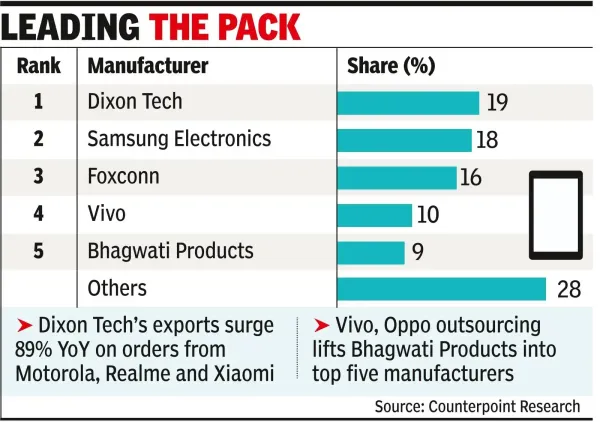
Dixon topped the electronics manufacturing services (EMS) rankings with a 19% market share, clocking an 89% jump in output, driven by rising orders from global brands such as Motorola, Realme and Xiaomi. The gains reflect a broader shift by smartphone makers towards outsourcing production to specialised partners.
According to Counterpoint Research, Foxconn ranked second with a 16% share, up from 12% a year earlier, largely on the back of export-linked shipments tied to Apple. Samsung, despite its scale, slipped to an 18% share from 20% in 2024, weighed down by relatively modest export growth.
Bhagwati Products — a joint venture between Micromax Informatics and Chinese original design manufacturer Huaqin Technologies — entered the top five with a 9% share. Its rise has been anchored in manufacturing mandates from Vivo, Oppo and Realme, underlining how Chinese brands are deepening local partnerships as they recalibrate supply chains.
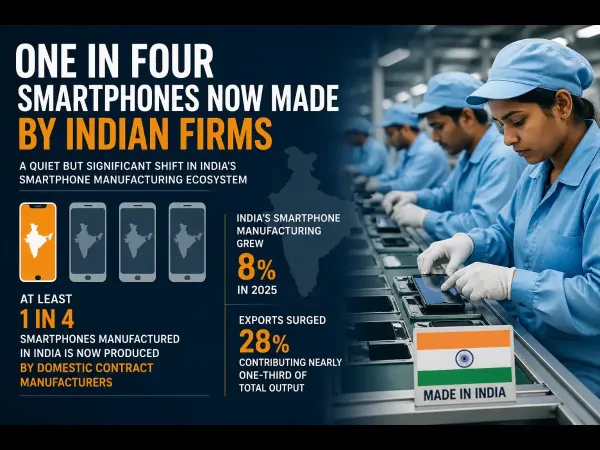
India’s smartphone manufacturing grew 8% in 2025, with exports surging 28% to account for nearly one-third of total output. Domestic demand, by contrast, remained largely flat, with sales inching up just 1%.
Analysts say policy support — including production-linked incentives (PLI) and relaxed foreign investment norms — has helped accelerate this transition. Abdul Rahman Khan, research analyst at Counterpoint Research, said Oppo and Vivo’s outsourcing strategy marked a turning point.
Also Read: Smartphone sales fall 9% on rising memory prices
“Oppo and Vivo began scaling outsourcing meaningfully around 2024, but volumes ramped up once it did, flowing to domestic manufacturers like Bhagwati Products,” Khan told TOI.
“In case of Bhagwati Products, its partnership with Huaqin, which has an established supply chain presence and relations in the industry, has also worked,” he added.
Heightened scrutiny of foreign direct investment has also nudged Chinese firms to partner with Indian companies through joint ventures to expand manufacturing locally.
“The PLI cycle nearing its end is also triggering a redistribution of volumes,” Khan said. “We are seeing a share of that shift towards players like Dixon Technologies as brands recalibrate cost and partnership strategies.”
Exports are expected to remain the primary growth engine in 2026, keeping smartphones at the centre of India’s electronics manufacturing push. However, analysts caution that risks persist.
“Near-term headwinds, such as disruptions due to the US-Iran war could impact logistics, while sustained increases in memory prices may create demand-side pressures over the longer term,” said Tarun Pathak, research director at Counterpoint Research.
The surge has been led by Dixon Technologies and Bhagwati Products, with Dixon emerging as India’s largest smartphone manufacturer in 2025, overtaking Samsung Electronics in overall production volumes.
Also Read: Smartphones emerge as India's export champions in FY26
Dixon topped the electronics manufacturing services (EMS) rankings with a 19% market share, clocking an 89% jump in output, driven by rising orders from global brands such as Motorola, Realme and Xiaomi. The gains reflect a broader shift by smartphone makers towards outsourcing production to specialised partners.
According to Counterpoint Research, Foxconn ranked second with a 16% share, up from 12% a year earlier, largely on the back of export-linked shipments tied to Apple. Samsung, despite its scale, slipped to an 18% share from 20% in 2024, weighed down by relatively modest export growth.
Image is an AI generated illustration
Bhagwati Products — a joint venture between Micromax Informatics and Chinese original design manufacturer Huaqin Technologies — entered the top five with a 9% share. Its rise has been anchored in manufacturing mandates from Vivo, Oppo and Realme, underlining how Chinese brands are deepening local partnerships as they recalibrate supply chains.
India’s smartphone manufacturing grew 8% in 2025, with exports surging 28% to account for nearly one-third of total output. Domestic demand, by contrast, remained largely flat, with sales inching up just 1%.
Dixon With 19% Share Emerges As Largest, Overtakes Samsung, Bhagwati Corners 9%
Analysts say policy support — including production-linked incentives (PLI) and relaxed foreign investment norms — has helped accelerate this transition. Abdul Rahman Khan, research analyst at Counterpoint Research, said Oppo and Vivo’s outsourcing strategy marked a turning point.
Also Read: Smartphone sales fall 9% on rising memory prices
“Oppo and Vivo began scaling outsourcing meaningfully around 2024, but volumes ramped up once it did, flowing to domestic manufacturers like Bhagwati Products,” Khan told TOI.
“In case of Bhagwati Products, its partnership with Huaqin, which has an established supply chain presence and relations in the industry, has also worked,” he added.
Heightened scrutiny of foreign direct investment has also nudged Chinese firms to partner with Indian companies through joint ventures to expand manufacturing locally.
“The PLI cycle nearing its end is also triggering a redistribution of volumes,” Khan said. “We are seeing a share of that shift towards players like Dixon Technologies as brands recalibrate cost and partnership strategies.”
Exports are expected to remain the primary growth engine in 2026, keeping smartphones at the centre of India’s electronics manufacturing push. However, analysts caution that risks persist.
“Near-term headwinds, such as disruptions due to the US-Iran war could impact logistics, while sustained increases in memory prices may create demand-side pressures over the longer term,” said Tarun Pathak, research director at Counterpoint Research.