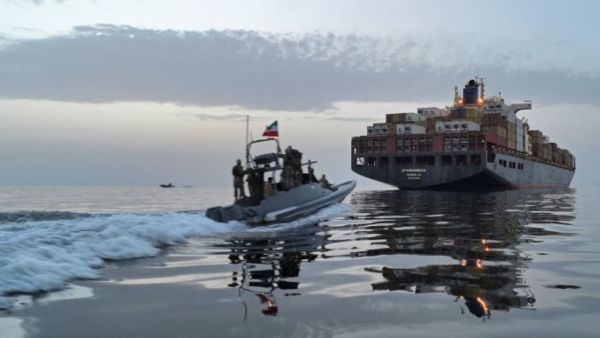
The United States said it disabled two Iranian-flagged oil tankers in the Gulf of Oman on Friday, May 8, intensifying maritime tensions in the region even as Washington and Tehran continue indirect diplomatic efforts aimed at ending the conflict.
US Central Command (CENTCOM) said an F/A-18 Super Hornet struck the empty tankers, identified as M/T Sea Star III and M/T Sevda, using precision munitions fired into their smokestacks.
According to CENTCOM, the vessels were heading towards Iranian ports in violation of an ongoing US maritime blockade.

In a statement posted on X, the command said the tankers were disabled before entering Iranian waters and were no longer transiting towards Iran. The US military also claimed it had stopped a third Iranian-flagged vessel earlier this week.
Trump wants Iran deal framed as US victory: Report
US President Donald Trump believes any future agreement with Iran can be presented as a US victory, according to The Atlantic citing administration advisers.
The report said Washington believes the blockade is increasing pressure on Tehran, while Trump remains hesitant to resume military operations and wants to ease tensions ahead of a planned visit to China.
Five sailors missing after cargo vessel hit near Hormuz
An Iranian official said a cargo vessel caught fire near Minab after overnight exchanges of fire involving US forces in waters near the Strait of Hormuz and the Gulf of Oman.
According to Mehr News Agency, 10 sailors were injured and five others remain missing. Iranian officials said it was not immediately clear whether the vessel had been directly targeted.
UAE to announce school learning model on May 10
The UAE Ministry of Education said it will announce on Sunday, May 10, evening whether schools will continue with in-person or remote learning after assessing the current situation with relevant authorities.
The ministry confirmed that examinations and international assessments will continue in person, adding that schools are prepared to shift between learning models if needed.
Iran adviser says Strait of Hormuz is like an ‘atomic bomb’
An adviser to Iran’s Supreme Leader has compared control over the Strait of Hormuz to possessing an “atomic bomb”, highlighting the strategic importance of the key global oil shipping route.
Mohammad Mokhber said the strait gives Iran the power to influence the global economy “with a single decision” and vowed Tehran would not “forfeit the gains of this war”, according to Mehr News Agency.
He also said Iran could seek changes to the legal regime governing the waterway.
US destroyers deployed in Arabian Sea
In a post on X, CENTCOM also released photographs of the USS Truxton (DDG 103), USS Rafael Peralta (DDG 115) and USS Mason (DDG 87) operating in the Middle East.
The command said the three destroyers were currently sailing in the Arabian Sea in support of the blockade against Iran.
According to CENTCOM, US forces have so far redirected 57 commercial vessels and disabled three ships in an effort to prevent vessels from entering or leaving Iranian ports.
Clashes reported near Strait of Hormuz
The developments came amid reports of sporadic clashes between Iranian armed forces and US naval vessels in the Strait of Hormuz, one of the world’s most important oil shipping routes.
Iran’s Fars news agency reported exchanges of fire beginning earlier on Friday in the strategic waterway linking the Gulf to the Arabian Sea.
Iranian officials also alleged that overnight US military strikes near the Strait of Hormuz hit an Iranian cargo vessel, injuring 10 sailors and leaving five others missing.
Mohammad Radmehr, an official in Iran’s Hormozgan province, told Mehr news agency that the vessel caught fire near Minab during what he described as “aggressive actions” by American forces in the Gulf of Oman region.
Iran condemns US actions
Iran’s foreign ministry condemned the reported strikes on the tankers, calling them violations of the ceasefire and international law.
Foreign ministry spokesperson Esmail Baghaei accused Washington of “adventurism and roguish behaviour” and warned that Iranian forces were fully prepared to respond to any escalation.
A senior Iranian lawmaker also warned that any future US naval blockade measures would face a military response from Tehran, according to Fars News.
Iranian Foreign Minister Abbas Araghchi criticised Washington’s approach, saying the United States repeatedly chose military escalation instead of diplomacy. “Every time a diplomatic solution is on the table, the US opts for a reckless military adventure,” Araghchi wrote on X.
US awaits Iran response to proposal
Despite the military escalation, diplomatic engagement between Washington and Tehran continued behind the scenes.
US Vice President JD Vance held talks with Qatar’s prime minister as efforts intensified to secure a negotiated end to the conflict, according to Axios.
US Secretary of State Marco Rubio said Washington expected Iran’s response within hours to a proposed framework aimed at ending hostilities.
“We’ll see what the response entails. The hope is it’s something that can put us into a serious process of negotiation,” Rubio told reporters during a visit to Rome.
Iranian officials, however, signalled that key issues remain unresolved. Foreign ministry spokesperson Esmail Baghaei reiterated that Tehran seeks a “permanent declared end to the war on all fronts” alongside guarantees that hostilities would not resume.
Iran also maintained that sovereignty over the Strait of Hormuz was “non-negotiable” and rejected US demands related to its nuclear programme, including calls to surrender enriched uranium stockpiles or dismantle nuclear facilities.
Regional tensions deepen
The conflict continued to strain relations between Washington and several allies.
Italian Foreign Minister Antonio Tajani described talks with the US delegation in Rome as positive despite disagreements over Iran policy. Italian Prime Minister Giorgia Meloni has publicly criticised recent remarks by US President Donald Trump, contributing to diplomatic friction between the two allies.
Rubio also acknowledged tensions within NATO after some countries reportedly refused to allow the US military to use bases or airspace linked to operations near Iran.
“If one of the main reasons why the US is in NATO is the ability to have forces deployed in Europe that we could project to other contingencies, and now that’s no longer the case, at least when it comes to some NATO members, that’s a problem,” Rubio said.
Meanwhile, two Saudi sources told AFP that US forces still had access to Saudi airspace and bases despite reports Riyadh had objected to their use during recent operations in the Gulf.
UAE intercepts missiles and drones
The United Arab Emirates (UAE) said its air defences intercepted two ballistic missiles and three drones launched from Iran on Friday.
The UAE Ministry of Defence said three people were injured in the latest attacks. Authorities added that since the start of the conflict, the country had intercepted 551 ballistic missiles, 29 cruise missiles and more than 2,200 drones.
The ministry urged residents to avoid approaching debris from intercepted projectiles.
Oil markets and shipping concerns
CENTCOM said more than 70 tankers carrying an estimated 166 million barrels of Iranian oil were currently being prevented from entering or leaving Iranian ports under the US blockade.
An international tanker-tracking website also reported that three empty Iranian-flagged tankers had turned back towards Iran after moving through areas monitored by US naval forces near the Strait of Hormuz.
Financial markets reacted cautiously to the developments. Brent crude edged up to USD 100.15 a barrel, while global equities and US stock markets closed lower amid growing concerns over the stability of energy supplies and regional security.
India monitors Gulf situation
Indian officials said all Indian seafarers in the Gulf region remained safe despite the escalating tensions.
Director at India’s Ministry of Ports, Shipping and Waterways, Opesh Kumar, said more than 3,000 Indian nationals had already been repatriated while ports across the region continued operating normally.
India’s Ministry of External Affairs also said flight operations to India were improving, with Kuwait, Bahrain and Iraq reopening their airspace for flights. Iran’s airspace has also partially reopened, according to Additional Secretary (Gulf) Aseem R Mahajan.
Hezbollah-Israel exchanges continue
The wider regional conflict also showed signs of spreading further.
Hezbollah said it launched missiles towards a military base near the Israeli city of Nahariya in response to Israeli strikes on southern Lebanon and Beirut’s southern suburbs.
The Israeli military said air raid sirens sounded across several northern cities and confirmed that at least one projectile was intercepted while others landed in open areas. No casualties were reported.
Israeli airstrikes on southern Lebanon later killed at least five people, according to Lebanese health authorities.
-
Danger of bird flu is increasing in Maharashtra, how the infection is spreading among humans; Learn the symptoms and treatment

-
Ube Coffee: This purple coffee has become the new trend of Instagram, have you tried it?

-
Simple steps to know the right bra size

-
HPSCB has announced recruitment for 91 posts, apply till May 29, know eligibility, selection process and salary.

-
Bad news is coming on petrol and diesel! Loss of Rs 1 lakh crore by oil companies, will the prices change tomorrow?