Gold, Silver Alert! Why Did PM Modi say not to buy gold for 1 year? Simple Math Of USD-INR-Gold
Sanjeev Kumar | May 11, 2026 5:23 PM CST
For a country like India, gold is not just a shiny piece of jewelry to buy. Holding gold has a deeper meaning, deeper love and far more significance in India, one that is rooted within its culture for decades.
So when Prime Minister Narendra Modi asked Indians to stop buying gold for a year, it came as a surprise or unusual. However, there is a reason why PM Modi asked citizens to avoid this precious metal.
Why Did PM Modi Say Not To Buy Gold For 1 Year?
PM Modi rolled out a list of practices that could help the economy survive against the latest West Asia war, which has brought global economies to the brink of mayhem.
During his speech in Hyderabad on Sunday, May 10th, PM Modi said, "Petrol-diesel has become so expensive across the world. It is the responsibility of all of us that the foreign exchange spent on purchasing petrol-diesel should also be saved by conserving petrol-diesel."
Amidst this, PM Modi dropped yet another appeal, one that has sent jewelry stocks in a frenzy on Indian stock exchanges on May 11th. He said, "I would appeal to people not to buy gold for weddings for one year."
Now one would wonder, why appeal to avoid gold? That is because there is one thing common when it comes to gold and crude oil for India: they both are linked in US dollars.
How Gold Is Linked With the Dollar And What It Means For India?
India is the second largest buyer of gold in the world after China. The World Gold Council report for 2025 showed that India's gold consumption stood at 711 tons by 2025, following closely to China whose gold consumption stood at 792 tons.
Majority of this gold is imported and every ounce is purchased in dollars. In FY26, India's gold import stood at $72 billion, a surge of 24% from the previous year. So here's what happened:
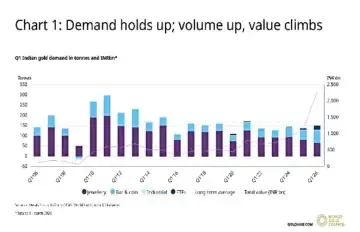 The WGC report said gold imports averaged 83 tons in the first two months of 2026, well above the 2025 monthly average of 53 tons, largely supported by strong investment demand during January. The late-February geopolitical developments in the Middle East and the related logistical disruptions to gold shipments from the UAE - a key gold import route for Indiaimpacted bullion imports in March. Imports in Q1 at 186t were up 58% yoy.
- FY26 Total Imports of India: $775 Billion
- Of this total, 4 Commodities Imports were at $240 Billion
The WGC report said gold imports averaged 83 tons in the first two months of 2026, well above the 2025 monthly average of 53 tons, largely supported by strong investment demand during January. The late-February geopolitical developments in the Middle East and the related logistical disruptions to gold shipments from the UAE - a key gold import route for Indiaimpacted bullion imports in March. Imports in Q1 at 186t were up 58% yoy.
However, RBI's gold reserves dropped in the latest fortnight ending on May 1, 2026, to $115.216 billion, which was down for second consecutive week.
What Happens If You Stop Buying Gold For 1 Year?
Internationally, gold prices are quoted in US dollars per troy ounce. Since India imports most of its gold, this price is converted to rupees using the current exchange rate. That's why any movement in the currency exchange rate directly affects the domestic gold prices. If the rupee is weaker, gold becomes costlier, and vice versa, as per the Poonawalla Fincorp website explainer.
Here's a simple math problem: Let's say gold per troy ounce is at $4,600
At Rs 80 per dollar, India is paying Rs 368,000 for gold.
At Rs 95 per dollar, India is paying Rs 437,000 for the same gold per troy ounce.
Hence, even if gold prices are stable in the international market, a combination of a weak rupee and a stronger dollar eventually makes imports extremely costly.
Unlike crude oil imports, which are non-negotiable, gold is discretionary spending. So if thousands or millions of people stopped buying gold for a year, it would play a key role in reducing the import burden and further curbing the account deficit of the country.
PM Modi said, "Gold purchases are another area where foreign exchange is used extensively. In the national interest, we must resolve not to purchase gold for a year."
He further said, "The growing culture of weddings abroad, travelling abroad and vacationing abroad is becoming prevalent among the middle class. During this crisis, we should postpone travelling abroad for at least a year."
Gold Outlook For India?
As per WGC, India's gold demand is likely to be anchored by investment interest, supported by price momentum, geopolitical risks, and subdued domestic financial markets. However, a rise in external risks and a potentially below-normal monsoon could weigh on growth and incomes, while inflationary pressures, partly driven by Middle East tensions, may dampen consumption, especially in price-sensitive segments. Amid these headwinds, investment demand is likely to remain firm, while jewelry demand may continue to face pressure, reinforcing the investment-led trend.
| Item | As on May 01, 2026 (₹ Cr.) | As on May 01, 2026 (US$ Mn.) | Week Variation (₹ Cr.) | Week Variation (US$ Mn.) |
|---|---|---|---|---|
| 1. Total Reserves | 65,56,404 | 6,90,693 | -25,983 | -7,794 |
| 1.1 Foreign Currency Assets # | 52,38,072 | 5,51,825 | 11,464 | -2,797 |
| 1.2 Gold | 10,93,660 | 1,15,216 | -39,415 | -5,021 |
| 1.3 SDRs | 1,78,350 | 18,789 | 1,433 | 15 |
| 1.4 Reserve Position in the IMF | 46,321 | 4,863 | 536 | 8 |
READ NEXT
-
Railway Pensioners Get Major Relief as DR Rises to 60%; Monthly Pension Amounts to Increase
-
New Highway Investment Rules May Boost Pension Returns and Reduce Government Borrowing
-
EPFO 3.0 to Transform PF Withdrawals; ATM and UPI Access Set to Make Process Faster
-
Sharing Your Credit Card With Friends or Family? It Could Trigger an Income Tax Notice
-
Petrol and Diesel Prices May Rise Soon as Oil Firms Face Heavy Losses Amid Global Crude Surge