Healthcare in India is no longer just about visiting a doctor when you fall sick. It is about planning in a world where medical inflation is rising faster than salaries and savings. A single hospitalisation can quietly undo years of financial discipline. This is why the debate around mediclaim vs health insurance has become more relevant than ever as we step into 2026.
At first glance, both options appear similar. They promise financial support during medical emergencies. But when you look closely, their scope, benefits, and long-term value differ significantly. Choosing the right one today could mean the difference between peace of mind and financial stress tomorrow.
Understanding Mediclaim and Health Insurance
Before comparing the two, it is important to understand what each product actually offers.
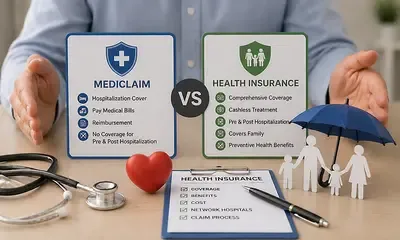
- A mediclaim policy is a basic form of health coverage. It primarily pays for expenses incurred during hospitalisation due to illness, injury, or surgery. The payout is linked strictly to the actual medical bills, subject to the sum insured.
- Health insurance, on the other hand, is broader in nature. It goes beyond hospitalisation and often includes pre and post-hospitalisation costs, outpatient care, diagnostic tests, critical illness cover, and sometimes even wellness benefits.
This core difference underpins the mediclaim vs. health insurance discussion.
What Does a Mediclaim Policy Cover?
Mediclaim policies are designed for simplicity and affordability. They are often chosen by individuals who want basic protection without complex features.
Key aspects include:
● Coverage for hospital room rent, doctor fees, nursing charges, and medicines during hospital stays.
● Available as individual plans or family floater plans.
● Usually includes cashless treatment options at network hospitals.
However, mediclaim has clear limitations:
● Expenses before admission and after discharge are usually excluded.
● OPD consultations, diagnostic tests, and long-term treatments are not covered.
● The sum insured is often lower, which can become a constraint during major medical emergencies.
Mediclaim works well as an entry-level safety net, but it may not be enough on its own in 2026.
What Makes Health Insurance More Comprehensive?
Health insurance plans are built for modern healthcare needs. They recognise that treatment does not start and end at the hospital door. These plans cover hospitalisation along with pre and post-hospitalisation expenses such as diagnostic tests, follow-up consultations, and medicines. Many policies also include coverage for critical illnesses, daycare procedures, mental health support, and wellness programs.
Another key advantage is flexibility. Health insurance plans offer add-ons such as maternity benefits, personal accident cover, and critical illness riders. Higher sums insured ensure better financial protection against rising medical costs.
While premiums are higher than mediclaim, the coverage is significantly broader, making health insurance a long-term solution rather than just a backup.
Key Differences Between Mediclaim and Health Insurance
When comparing mediclaim and health insurance, the differences become clearer when viewed through a practical lens:
| Feature |
Mediclaim |
Health Insurance |
| Scope of Coverage |
Primarily covers hospitalisation expenses |
Covers hospitalisation plus related medical costs before and after admission |
| Sum Insured & Flexibility |
Usually lower coverage and limited flexibility |
Higher coverage limits with options for customisation |
| Complexity & Cost |
Simpler and more affordable |
More detailed, often higher cost, but better long-term value |
| Purpose |
Basic protection |
Comprehensive financial security |
Ultimately, the choice depends on whether you seek basic protection or comprehensive financial security.
Who Should Choose Mediclaim?
Mediclaim can be suitable for young individuals with minimal health risks who are looking for an affordable way to protect themselves against sudden hospitalisation costs.
It can also work as a supplementary cover for those who already have employer-provided health insurance and want an extra layer of protection at a low cost. However, relying solely on mediclaim in the long run may leave gaps that become expensive later.
Who Should Choose Health Insurance?
Health insurance is better suited for:
● Families and individuals with dependents.
● People with lifestyle-related health risks.
● Those planning for long-term healthcare needs.
As medical expenses continue to rise, comprehensive coverage ensures that savings meant for life goals are not diverted towards treatment costs.
For anyone thinking ahead to 2026 and beyond, health insurance offers stability, flexibility, and broader financial protection.
The Role of Employer-Provided Coverage
Many people assume that corporate health insurance is enough. While employer coverage is helpful, it often comes with limitations such as lower sums insured and a lack of portability.
Once you switch jobs or take a career break, the coverage disappears. This is why personal health insurance is essential, regardless of what your employer offers.
Mediclaim or health insurance purchased independently ensures continuity and control over your healthcare protection.
Planning for 2026 and Beyond
Healthcare trends indicate rising costs, increasing lifestyle diseases, and longer recovery periods. In such a landscape, basic hospital-only coverage may fall short. The mediclaim vs health insurance debate is no longer about which is cheaper. It is about which one aligns with future realities.
Health insurance addresses not just treatment costs but the financial impact of recovery, diagnostics, and long-term care. It supports you through the entire healthcare journey, not just the hospital stay.
Making the Right Choice
If the budget is a major constraint and you want minimal coverage, mediclaim can be a starting point. But if you are looking for long-term security, flexibility, and better financial planning, health insurance is the wiser choice. Many individuals also choose a combination strategy, starting with health insurance and adding top-up or critical illness covers as their needs evolve.
Trusted insurers like Aviva India offer solutions such as Aviva Smart Vital that balance coverage, flexibility, and long-term value while keeping customer needs at the centre.
Conclusion
Choosing between mediclaim and health insurance is not just an insurance decision. It is a life decision shaped by your goals, responsibilities, and vision for the future. Mediclaim offers simplicity and affordability. Health insurance offers depth, flexibility, and resilience. As 2026 approaches with its own set of uncertainties, the smarter choice prepares you not just for emergencies but for recovery, continuity, and peace of mind.
When you look beyond premiums and focus on protection, the answer to mediclaim vs health insurance becomes clearer. It is about choosing coverage that grows with you and stands by you when it matters most.
-
Apara Ekadashi 2026: Can ‘unknowing sins’ really be erased by a fast? Know the religious secret of this holy day

-
206 bones will remain strong even at the age of 40, keep the list of native foods bone healthy; List of Tajjas

-
Mahindra April 2026 Sales Report: Company Sold 94,627 Units With 14% Growth — Check Top-Selling Vehicles

-
Bayer’s relationship with farmers strengthened! ‘Farm Rise’ application reaches 50 lakh farmers

-
Google will compete with MacBook Neo, bringing AI laptop Googlebook