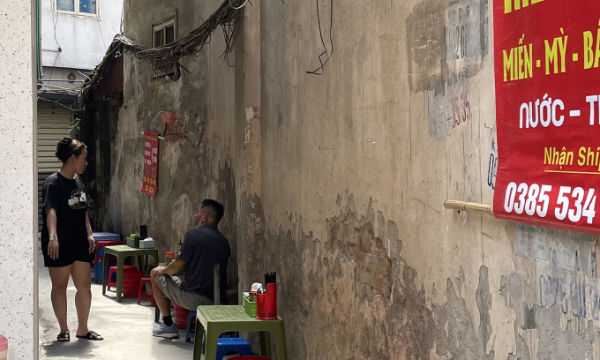
At 10 a.m., Huong Hanh, 57, sat waiting for customers at the mouth of a one meter wide alley on Hang Chao Street in O Cho Dua Ward.
Inside, her daughter served guests: Four plastic tables were lined tightly against the wall, leaving room for only one person to walk through; the cooking area had been moved into the family kitchen.
For more than a decade, Hanh’s bun rieu (crab noodle soup) stall operated on the sidewalk across the street beneath the stands of Hang Day Stadium.
The stall once had 10 tables and sold 80-100 bowls a day. But this past month, as authorities stepped up enforcement against sidewalk encroachment, she moved into the alley to avoid the fine of VND2.5 million (US$95) and seizure of equipment. “Customers still aren’t used to the new location, and so I have to sit outside and call them in,” Hanh says.
Since moving, her sales have fallen to just a third of what they used to be. On rainy days, the stall has to close because it has no roof. Most sidewalk eateries in the area have shut down, and Hanh’s is among the few still surviving. “I don’t have a pension, so I want to keep selling for a few more years to reduce the burden on my children,” Hanh says.
|
Huong Hanh’s crab noodle soup stall, relocated from the sidewalk into an alley on Hang Chao Street in O Cho Dua Ward, on May 5, 2026. Photo by Read/Quynh Duong |
Next to her stall, Van’s iced tea stand has also moved off the sidewalk and into the porch of a nearby house. Whenever customers stop for a drink, she gives up the only chair and stands aside. “Now I sell mostly to keep myself occupied,” she says.
Hanoi is carrying out Plan 332, a citywide campaign aimed at reclaiming sidewalks for pedestrians. Authorities have stepped up enforcement, including the use of surveillance cameras, and remotely issue fines.
Hanoi has around 1,100 streets with sidewalks, according to official statistics. A 2025 survey by its Department of Construction covering 120 streets found that more than 90% of sidewalks were encroached for business activities or parking.
Unlike previous short term crackdowns, Plan 332 is being implemented in three stages: public awareness campaigns, inspections and enforcement, and long term monitoring to prevent violations from recurring.
City authorities expect that a combination of stricter policies and surveillance using technology will help prevent sidewalk encroachment. The city police chief has also requested greater accountability for local officials responsible for urban order.
Those who allow repeated sidewalk violations face lower performance rankings or transfers. A representative of the Ngoc Ha Ward police said authorities had cleared unauthorized wet markets on Hoang Hoa Tham, Kim Ma Thuong, and Doi Can streets.
Security patrols now monitor the areas regularly to prevent vendors from returning. Besides, many of the vendors have voluntarily moved indoors.
 |
|
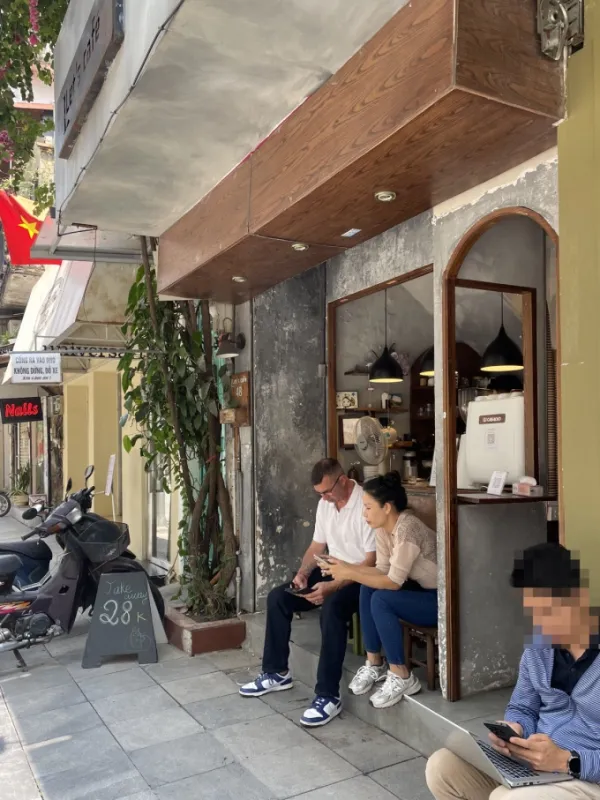
The coffee shop on Tran Quoc Toan Street promotes takeaway sales by offering all drinks at a fixed price on May 5, 2026. Photo by Quynh Duong |
The stricter enforcement has forced many workers who depend on the “sidewalk economy” to adapt. Some like Hanh have reduced the size of their business, while others have accepted high rents to move into buildings.
One noodle shop that previously operated on Hang Chao Street moved to a 100 sqm location on Giang Vo Street. Its owner says now the shop opens only from 7 a.m. to 1 p.m. besides sharing the space with a hotpot restaurant in the afternoon and evening to cover costs.
In Dong Xuan Ward, Ngan, the owner of a xoi khuc (spinach sticky rice balls stall), also moved to a rented store on Hang Khoai Street some 200 meters from her previous location for VND10 million rent a month, double her earlier rent. “I was lucky to secure a lease early, and so I found a place close to my old spot,” she says.
Without access to sidewalks, some businesses are changing their operating models. A coffee shop on Tran Quoc Toan Street in Cua Nam Ward now has only four chairs near its entrance. During busy hours, customers sit temporarily in nearby porches while staff stay ready to clear the area if inspectors pass by.
The owner says the shop cut drink prices from VND30,000-50,000 to a flat VND28,000 in the case of takeaways.
Associate Professor Dinh Trong Thinh, a former head of the international finance faculty at the Academy of Finance, says the campaign had admittedly made Hanoi’s streets more orderly, but authorities need to consider the livelihoods of small vendors. “Authorities should also consider piloting designated vending zones to create legal spaces for people to sell goods.”
-
We're all paying for Starmer's obstinacy - it's trouble if he stays but double if he goes

-
FDA Commissioner Marty Makary Resigns Amid Controversy and Political Pressure

-
Former Mayor's Plea Agreement Highlights Ties to Chinese Political Strategist

-
MP: Two minor girls die after lightning strike in Tikamgarh

-
It's time for Keir Starmer to go: Britain deserves better