
Listen to this article in summarized format
Loading...
××
Subscribe to

Unlock AI Briefing and Premium Content
New Year Offer 24 Hours Left
Subscribe NowAlready a member? Sign In
What's Included
- Exclusive Stories
- Daily ePaper Access
- Smart Market Tools
- Curated Investment Ideas
- Ad-lite Experience
Subscription

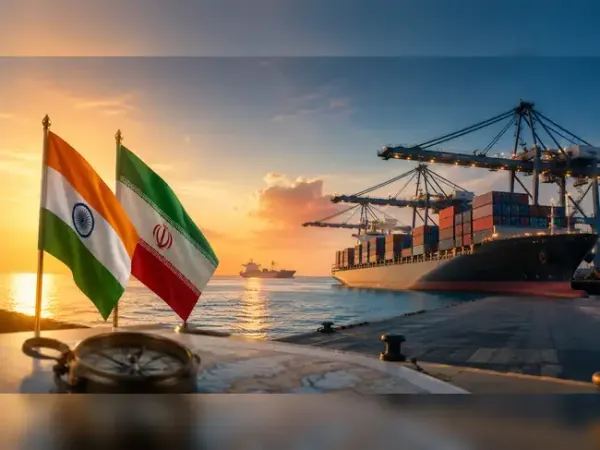
Chabahar uncertainty: Can India still reach Central Asia and Russia? (AI-generated image)
India's bet on an alternative trade route to Russia and Central Asia is at a crossroads. With the US sanctions waiver on Chabahar port expiring on April 26, 2026, India's role at the port has come under uncertainty, prompting questions about the future of the International North-South Transport Corridor (INSTC).
External Affairs Minister S. Jaishankar told Parliament in February that India "remains engaged with all concerned in order to address the implications of these developments." According to a Bloomberg report citing anonymous government officials,India is considering temporarily transferring its stake in the port to an Iranian entity while retaining the option to return, but that it does not plan to exit Chabahar entirely.
Also Read: India may temporarily transfer Chabahar Port stake to an Iranian entity before US sanctions kick in
India Ports Global Ltd (IPGL), which operated the Shahid Beheshti Terminal under a ten-year contract signed in May 2024, invested approximately $120 million in equipment procurement for the project. Replying to a question in the Rajya Sabha in February, Minister of State for External Affairs Kirti Vardhan Singh said the last tranche of the committed amount was transferred on August 26, 2025.
The US Secretary of State revoked the sanctions exception for Chabahar on September 29, 2025, under the Iran Freedom and Counter-Proliferation Act.
Following India's representation, the US Department of the Treasury issued a letter on October 28, 2025 extending a conditional sanctions waiver until April 26, 2026, the Ministry of External Affairs told Parliament in February.
There has been no official announcement of an exit. But for a corridor that was already struggling to reach commercial scale, the implications are significant.
What was INSTC supposed to be, and why did Chabahar matter?
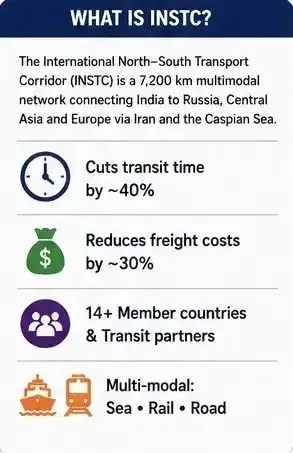
The International North-South Transport Corridor is a 7,200-kilometre multimodal network connecting India's western ports through Iran and the Caspian Sea to Russia, Central Asia and onward to Northern Europe via sea, rail and road. The corridor was originally signed in 2000 between Russia, India and Iran and now has more than 14 member and transit partners.
The corridor has three arms: a western route via Azerbaijan, a central trans-Caspian route, and an eastern route running through Kazakhstan and Turkmenistan. Proponents of the corridor say it can cut transit time by roughly 40 per cent and freight costs by around 30 per cent compared to the traditional Suez Canal route.
Chabahar's role within this framework was specific. The port, located on Iran's southeastern coast along the Arabian Sea, offered India a route to Afghanistan and Central Asia that bypassed Pakistan entirely. It was envisioned as the anchor of the eastern route, eventually to be connected to Iran's national rail grid through the Chabahar-Zahedan railway link.
Also Read: West Asia conflict deepens: India’s Chabahar port in Iran ‘under US air strikes’
"Chabahar is extremely important from India's diplomacy and commercial perspective," said Professor Rajan Kumar of the Centre for Russian and Central Asian Studies at JNU. "India would not like to exit from Chabahar. The port gives India access to Afghanistan without going through Pakistan, and it also lets India keep an eye on activities near Gwadar, which is China's exit point to the Indian Ocean."
Critically, Chabahar is not technically part of INSTC as it stands today. Its current Iranian node is Bandar Abbas. India had been pushing to formally include Chabahar in the corridor's framework, with plans to build rail and road connectivity northward to connect with the Caspian region, according to Professor Kumar.
Does INSTC survive without Chabahar?
The corridor's damage is real, but most analysts say it is not fatal. "It's not fatal, but surely a serious strategic setback," said Dr. Swaran Singh, Professor of Diplomacy and Disarmament at Jawaharlal Nehru University. "What is compromised is not the entire corridor, but India's agency within it. Without Chabahar, India operates INSTC as a passive user, not a founding architect."
Professor Harsh Pant, Vice President at the Observer Research Foundation (ORF), argued that India's move should be read as a calibrated adjustment rather than an abandonment. "India Ports Global Ltd is reportedly transferring its stake in the local operating entity to an Iranian partner while retaining the possibility of re-entry should the sanctions environment ease," he said. "New Delhi appears to have calculated that preserving long-term optionality is preferable to courting immediate sanctions exposure."
India had already been using the eastern INSTC corridor in operational terms. In March 2025, India shipped a cargo consignment from Mundra Port in Gujarat to Kazakhstan via the eastern route of the INSTC, travelling through Bandar Abbas Port, according to ORF research.
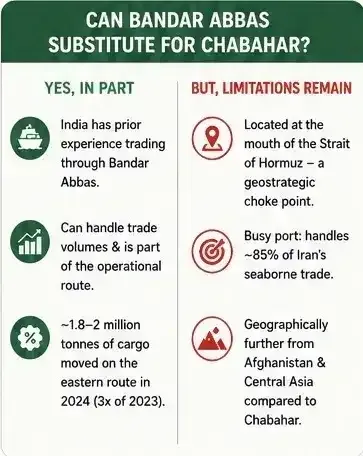
The Iranian Ambassador to Russia said approximately 1.8 million to 2 million tonnes of cargo were transported along the eastern branch in 2024, nearly three times the figure from 2023. Russia, Kazakhstan and Turkmenistan had also set up a joint venture offering transit tariff discounts of 20 to 40 per cent on this route, according to ORF.
Can Bandar Abbas substitute for Chabahar?
Bandar Abbas was always INSTC's original Iranian node, and India has prior experience trading through it. But substituting it for Chabahar carries structural problems.
Bandar Abbas handles approximately 85 per cent of Iran's seaborne trade, according to multiple port analyses, and sits at the mouth of the Strait of Hormuz. The strait has been the site of sustained disruption since the outbreak of the US-Iran conflict, with Tehran restricting vessels linked to the United States and Israel from navigating through it.
On May 8, the US military carried out strikes on Iran's Qeshm port and Bandar Abbas itself. "Substituting Bandar Abbas for Chabahar is like treating a strategic solution with a problem," said Dr. Singh.
Rajoli Siddharth Jayaprakash, Junior Fellow at ORF's Strategic Studies Programme, noted that Bandar Abbas can offset India's cargo volumes but may not carry the same strategic utility. "India's rationale to position Chabahar as its gateway to Eurasia was its larger goal of circumventing Pakistan," he said. "The port can substitute on trade volumes, but not necessarily on strategy."
Professor Kumar added that geography makes the distinction clear. Chabahar is on Iran's southeast coast, positioned more directly toward Afghanistan and Central Asia, while Bandar Abbas is further west. "Because India wanted access to Afghanistan, Chabahar was always more convenient," he said.
Is the window closing for good?
This is where analysts diverge most sharply. Former Ambassador Anil Trigunayat of India to Jordan, Libya and Malta maintained that India has not lost its window. "Both Iran and Russia remain India's strategic partners. These temporary difficulties are being handled through strategic patience and consistent diplomacy," he said.
Dr. Singh was more cautious. India made no budgetary allocation for Chabahar in the 2026-27 Union Budget, the first such omission in nearly a decade, as reported by ET Online. In the previous year, the project had received Rs 400 crore in Budget Estimates. "A prolonged zero-budget will begin to signal institutional abandonment," he said. "Every year India remains absent at Chabahar, Iran, Russia, and China will recalibrate the corridor's architecture without Indian inputs."
The China variable is one that multiple analysts flagged. Iran is reportedly engaging with Chinese investment interests at Chabahar, given its proximity to Gwadar. "Beijing's entry may not be immediate," said Jayaprakash, "but if consolidated, it could make India's re-entry structurally more expensive and cumbersome."
Is India losing Central Asia's connectivity map to rivals?
Since last year, a policy recalibration has been observed in Central Asia. Pakistan's leadership has held summit-level talks with all five Central Asian states, with access to Pakistani ports as the central pitch, according to Jayaprakash. Central Asian countries are actively exploring alternative routes toward the Arabian Sea, even as overland infrastructure linking them to Pakistan remains underdeveloped.
"In the short to medium term, India's interest could be impacted," said Jayaprakash. "But the overland infrastructure between Central Asian states and Pakistan has not yet attained commercial scalability."
Dr. Singh framed the risk differently. "The danger for India is not that these alternative routes may replace INSTC, but that Central Asian countries will diversify away from Indian-linked routes while India remains diplomatically absent, eventually making India's re-engagement irrelevant to their logistical architecture."
What needs to change for INSTC to become viable?
There is broad consensus on the conditions: a significant easing of sanctions on both Iran and Russia, an end to the conflicts in Ukraine and Iran, and completion of critical missing rail links, particularly the Rasht-Astara railway on the western route.
Russia committed a $1.6 billion loan toward the 162-kilometre Rasht-Astara railway, with construction by Russian contractor Caspian Service set to begin in early 2026, according to Iran's Ministry of Roads and Urban Development. The current status of that timeline following the Iran war is not confirmed.
Also Read: India, Iran hold talks on "bilateral and regional issues"
"Ideally, unilateral sanctions regimes must be dispensed with, and the rule of law and conventions must be followed and respected," said Ambassador Trigunayat.
Dr. Singh added further, "INSTC's revival ultimately depends less on Iranian infrastructure and more on whether New Delhi can demonstrate the strategic resolve to pursue its own Eurasian interests independently of Washington's sanctions architecture. No corridor can be built on the reputational foundation of a power that withdraws when pressures are high."
For now, India's official position is one of watchful engagement. Chabahar's long-term viability remains intact in the view of most analysts, but only if the geopolitical environment shifts, the infrastructure gaps are closed, and New Delhi re-enters the corridor before others shape it without Indian inputs.
External Affairs Minister S. Jaishankar told Parliament in February that India "remains engaged with all concerned in order to address the implications of these developments." According to a Bloomberg report citing anonymous government officials,India is considering temporarily transferring its stake in the port to an Iranian entity while retaining the option to return, but that it does not plan to exit Chabahar entirely.
Also Read: India may temporarily transfer Chabahar Port stake to an Iranian entity before US sanctions kick in
India Ports Global Ltd (IPGL), which operated the Shahid Beheshti Terminal under a ten-year contract signed in May 2024, invested approximately $120 million in equipment procurement for the project. Replying to a question in the Rajya Sabha in February, Minister of State for External Affairs Kirti Vardhan Singh said the last tranche of the committed amount was transferred on August 26, 2025.
The US Secretary of State revoked the sanctions exception for Chabahar on September 29, 2025, under the Iran Freedom and Counter-Proliferation Act.
Following India's representation, the US Department of the Treasury issued a letter on October 28, 2025 extending a conditional sanctions waiver until April 26, 2026, the Ministry of External Affairs told Parliament in February.
There has been no official announcement of an exit. But for a corridor that was already struggling to reach commercial scale, the implications are significant.
What was INSTC supposed to be, and why did Chabahar matter?
The International North-South Transport Corridor is a 7,200-kilometre multimodal network connecting India's western ports through Iran and the Caspian Sea to Russia, Central Asia and onward to Northern Europe via sea, rail and road. The corridor was originally signed in 2000 between Russia, India and Iran and now has more than 14 member and transit partners.
The corridor has three arms: a western route via Azerbaijan, a central trans-Caspian route, and an eastern route running through Kazakhstan and Turkmenistan. Proponents of the corridor say it can cut transit time by roughly 40 per cent and freight costs by around 30 per cent compared to the traditional Suez Canal route.
Chabahar's role within this framework was specific. The port, located on Iran's southeastern coast along the Arabian Sea, offered India a route to Afghanistan and Central Asia that bypassed Pakistan entirely. It was envisioned as the anchor of the eastern route, eventually to be connected to Iran's national rail grid through the Chabahar-Zahedan railway link.
Also Read: West Asia conflict deepens: India’s Chabahar port in Iran ‘under US air strikes’
"Chabahar is extremely important from India's diplomacy and commercial perspective," said Professor Rajan Kumar of the Centre for Russian and Central Asian Studies at JNU. "India would not like to exit from Chabahar. The port gives India access to Afghanistan without going through Pakistan, and it also lets India keep an eye on activities near Gwadar, which is China's exit point to the Indian Ocean."
Critically, Chabahar is not technically part of INSTC as it stands today. Its current Iranian node is Bandar Abbas. India had been pushing to formally include Chabahar in the corridor's framework, with plans to build rail and road connectivity northward to connect with the Caspian region, according to Professor Kumar.
Does INSTC survive without Chabahar?
The corridor's damage is real, but most analysts say it is not fatal. "It's not fatal, but surely a serious strategic setback," said Dr. Swaran Singh, Professor of Diplomacy and Disarmament at Jawaharlal Nehru University. "What is compromised is not the entire corridor, but India's agency within it. Without Chabahar, India operates INSTC as a passive user, not a founding architect."
What is INSTC?
Professor Harsh Pant, Vice President at the Observer Research Foundation (ORF), argued that India's move should be read as a calibrated adjustment rather than an abandonment. "India Ports Global Ltd is reportedly transferring its stake in the local operating entity to an Iranian partner while retaining the possibility of re-entry should the sanctions environment ease," he said. "New Delhi appears to have calculated that preserving long-term optionality is preferable to courting immediate sanctions exposure."
India had already been using the eastern INSTC corridor in operational terms. In March 2025, India shipped a cargo consignment from Mundra Port in Gujarat to Kazakhstan via the eastern route of the INSTC, travelling through Bandar Abbas Port, according to ORF research.
The Iranian Ambassador to Russia said approximately 1.8 million to 2 million tonnes of cargo were transported along the eastern branch in 2024, nearly three times the figure from 2023. Russia, Kazakhstan and Turkmenistan had also set up a joint venture offering transit tariff discounts of 20 to 40 per cent on this route, according to ORF.
Can Bandar Abbas substitute for Chabahar?
Bandar Abbas was always INSTC's original Iranian node, and India has prior experience trading through it. But substituting it for Chabahar carries structural problems.
Bandar Abbas handles approximately 85 per cent of Iran's seaborne trade, according to multiple port analyses, and sits at the mouth of the Strait of Hormuz. The strait has been the site of sustained disruption since the outbreak of the US-Iran conflict, with Tehran restricting vessels linked to the United States and Israel from navigating through it.
Can Bandar Abbas substitute for Chabahar?
On May 8, the US military carried out strikes on Iran's Qeshm port and Bandar Abbas itself. "Substituting Bandar Abbas for Chabahar is like treating a strategic solution with a problem," said Dr. Singh.
Rajoli Siddharth Jayaprakash, Junior Fellow at ORF's Strategic Studies Programme, noted that Bandar Abbas can offset India's cargo volumes but may not carry the same strategic utility. "India's rationale to position Chabahar as its gateway to Eurasia was its larger goal of circumventing Pakistan," he said. "The port can substitute on trade volumes, but not necessarily on strategy."
Professor Kumar added that geography makes the distinction clear. Chabahar is on Iran's southeast coast, positioned more directly toward Afghanistan and Central Asia, while Bandar Abbas is further west. "Because India wanted access to Afghanistan, Chabahar was always more convenient," he said.
Is the window closing for good?
This is where analysts diverge most sharply. Former Ambassador Anil Trigunayat of India to Jordan, Libya and Malta maintained that India has not lost its window. "Both Iran and Russia remain India's strategic partners. These temporary difficulties are being handled through strategic patience and consistent diplomacy," he said.
Dr. Singh was more cautious. India made no budgetary allocation for Chabahar in the 2026-27 Union Budget, the first such omission in nearly a decade, as reported by ET Online. In the previous year, the project had received Rs 400 crore in Budget Estimates. "A prolonged zero-budget will begin to signal institutional abandonment," he said. "Every year India remains absent at Chabahar, Iran, Russia, and China will recalibrate the corridor's architecture without Indian inputs."
The China variable is one that multiple analysts flagged. Iran is reportedly engaging with Chinese investment interests at Chabahar, given its proximity to Gwadar. "Beijing's entry may not be immediate," said Jayaprakash, "but if consolidated, it could make India's re-entry structurally more expensive and cumbersome."
Is India losing Central Asia's connectivity map to rivals?
Since last year, a policy recalibration has been observed in Central Asia. Pakistan's leadership has held summit-level talks with all five Central Asian states, with access to Pakistani ports as the central pitch, according to Jayaprakash. Central Asian countries are actively exploring alternative routes toward the Arabian Sea, even as overland infrastructure linking them to Pakistan remains underdeveloped.
"In the short to medium term, India's interest could be impacted," said Jayaprakash. "But the overland infrastructure between Central Asian states and Pakistan has not yet attained commercial scalability."
Dr. Singh framed the risk differently. "The danger for India is not that these alternative routes may replace INSTC, but that Central Asian countries will diversify away from Indian-linked routes while India remains diplomatically absent, eventually making India's re-engagement irrelevant to their logistical architecture."
What needs to change for INSTC to become viable?
There is broad consensus on the conditions: a significant easing of sanctions on both Iran and Russia, an end to the conflicts in Ukraine and Iran, and completion of critical missing rail links, particularly the Rasht-Astara railway on the western route.
Russia committed a $1.6 billion loan toward the 162-kilometre Rasht-Astara railway, with construction by Russian contractor Caspian Service set to begin in early 2026, according to Iran's Ministry of Roads and Urban Development. The current status of that timeline following the Iran war is not confirmed.
Also Read: India, Iran hold talks on "bilateral and regional issues"
"Ideally, unilateral sanctions regimes must be dispensed with, and the rule of law and conventions must be followed and respected," said Ambassador Trigunayat.
Dr. Singh added further, "INSTC's revival ultimately depends less on Iranian infrastructure and more on whether New Delhi can demonstrate the strategic resolve to pursue its own Eurasian interests independently of Washington's sanctions architecture. No corridor can be built on the reputational foundation of a power that withdraws when pressures are high."
For now, India's official position is one of watchful engagement. Chabahar's long-term viability remains intact in the view of most analysts, but only if the geopolitical environment shifts, the infrastructure gaps are closed, and New Delhi re-enters the corridor before others shape it without Indian inputs.