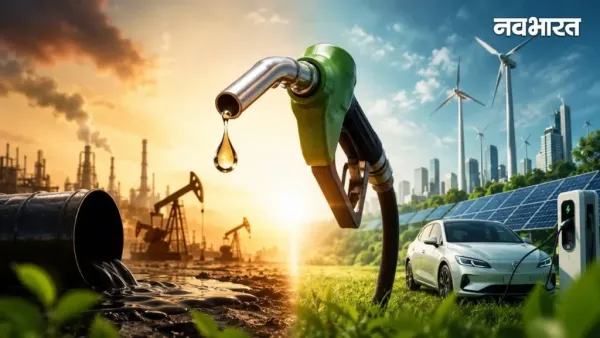
Alternative to Petrol-Diesel: The effects of the ongoing tension in the Middle East for the last two months are now being seen all over the world. Crude oil prices are rising rapidly in the global market. Due to this, Indian oil companies have also increased the prices of petrol and diesel, which has been implemented across the country from Friday, May 15. For some time, the Indian government and oil companies were incurring huge losses to keep fuel prices stable.
To reduce this loss, the prices of petrol and diesel have been increased by Rs 3 each. Due to change in oil prices, petrol is being sold at Rs 97.77 a liter while diesel is being sold at Rs 90.67 a liter in the capital Delhi from today. Earlier, petrol was being sold at Rs 94.77 a liter and diesel at Rs 87.67 a litre.
Prices increased by 50% in other countries of Asia
The prices of petrol and diesel are sky high not only in India but also in different parts of the world. If we talk about other countries of Asia except India, there has been an increase of more than 50 percent in the prices of petrol and diesel. At present, meeting the need of fuel consumption is becoming a big challenge for many countries as well as India. This is the reason why Prime Minister Narendra Modi is constantly appealing to the people of the country to save fuel and spend it in a well-thought-out strategy. But, the biggest question is that apart from petrol and diesel which are becoming increasingly expensive, what other fuel options can India have? Let us understand all those possibilities in detail.
India imports 85% of its oil needs
Amidst the skyrocketing prices of crude oil in the international market and the oil crisis, maintaining its energy security is no less than a challenge for India. India imports about 85 percent of its crude oil requirement from other countries, which is a big burden on the country’s economy. Amid global uncertainties, India has many strong and practical options to reduce the pressure of petrol and diesel becoming increasingly expensive, on which the government is working rapidly.
1. Ethanol Blending and Flex-Fuel
In recent times, running vehicles by mixing ethanol in petrol has proved to be the fastest and most successful option in India. India has achieved the target of blending 20% ethanol (E20) in petrol, saving billions of dollars of foreign exchange. The government is now working on setting rules for E85 (85% ethanol) and 100% ethanol (E100) fuels in the country.
Apart from this, on the lines of countries like Brazil, ‘Flex-Fuel Vehicles’ (FFVs) are being promoted, which can run entirely on ethanol or any petrol-ethanol mixture. This fuel is made from sugarcane juice, maize and agricultural residues (like stubble), which also benefits farmers.
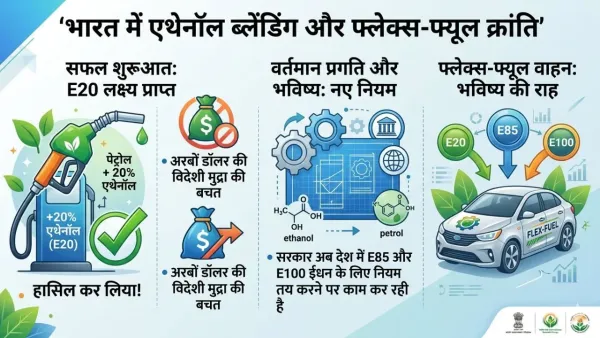
Ethanol Blending and Flex-Fuel
2. Rapid expansion of electric vehicles
Apart from petrol and diesel, India has the best option for electric vehicles. The EV revolution in India has grown very rapidly through electric scooters and e-rickshaws. Public transport (such as electric buses) and commercial delivery fleets are also rapidly shifting to batteries.
3. New impetus to CNG and LNG
India is increasing the share of natural gas in its economy. More than 25,400 km long gas pipeline network has been ready in the country. Amidst the ongoing crisis in the Middle East, the Government of India, working on a war footing, has given a new impetus to CND and LNG. Liquefied Natural Gas is being promoted as an alternative to diesel for long distance vehicles, which is much cheaper and less polluting than diesel.
4. Government also emphasizes on green hydrogen
Green hydrogen has proven to be the biggest game-changer for heavy commercial vehicles such as large trucks, trains and ships, which cannot be run on electric batteries. The government has made a total budgetary provision of over Rs 17,500 crore under the National Green Hydrogen Mission, which aims to produce 5 million metric tonnes of green hydrogen annually by 2030. The country’s major automobile companies such as Tata Motors and Ashok Leyland are developing prototypes of hydrogen-powered commercial vehicles.
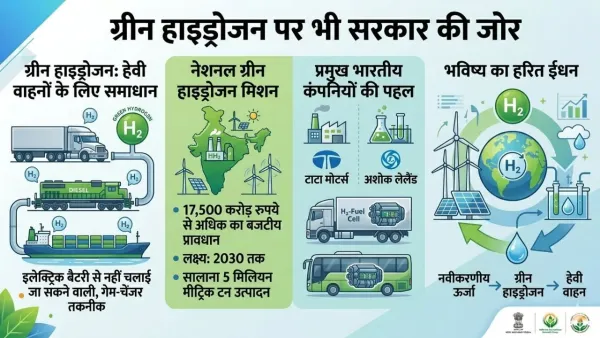
Indian government eyes green hydrogen
5. Bio-diesel and compressed bio-gas
Compressed bio-gas is produced from agricultural waste, animal dung and urban wet waste. (CBG) is being made, which directly cng trains And can replace LPG cylinders. Apart from this, the target of mixing bio-diesel (which is made from non-edible oils and waste cooking oil) in conventional diesel is also being continuously increased.
6. Electricity generation from alternative energy sources
Apart from providing direct relief to the transport sector, India is also reducing dependence on coal and gas for its domestic power needs. More than 50% of the country’s total installed power capacity now comes from non-fossil (solar energy, wind energy and hydropower) sources. This will make the grid-based charging infrastructure completely ‘clean and green’ Getting help in making it.
-
In Himachal Pradesh, tourism and migration are altering beliefs that kept forests safe

-
Bharmour Meat Shop Union Takes Steps to Respect Religious Sentiments

-
Storm wreaks havoc in Kembhavi; roof of marriage hall collapses

-
Aldi confirms bananas last longer without going brown if stored in 1 kitchen appliance

-
UK's new longest outdoor tubing slide looks incredible fun - opens on May 22