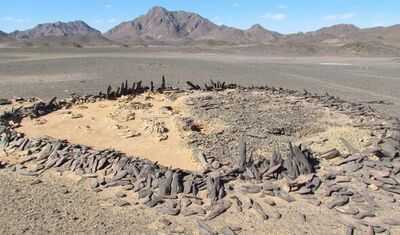
An international team of archaeologists using satellite technology has discovered 260 gigantic, 6,000-year-old mass graves hidden across the sun-scorched Atbai Desert of Eastern Sudan. The sprawling "enclosure burials" - some measuring up to 80 meters in diameter - reveal a highly sophisticated, prehistoric nomadic empire that flourished just before the rise of the Egyptian Pharaohs, but researchers warn the ancient sites are now facing immediate, catastrophic destruction.
Dr Julien Cooper, the lead researcher from Macquarie University: "Our discovery reshapes the story of the Sahara deserts and the prehistory of the Nile. These burial enclosures tell us even scattered nomads were extremely well-organised people, and expert adapters. They provide a prologue for the monumentalism of the kingdoms of Egypt and Nubia, and an image of this region as more than pharaohs, pyramids and temples."
However, the groundbreaking discovery comes with a severe warning. The region is currently gripped by an intense, unregulated gold rush and civil conflict, leaving the ancient monuments entirely unprotected.
Dr Cooper said: "Sadly, many of these enclosure monuments are currently being destroyed or vandalised as a result of unregulated mining in the region. These unique burials have survived for millennia, but can disappear in less than a week."
The monuments, dating primarily to the fourth and third millennia BCE, consist of large circular walls containing carefully arranged burials. Human skeletons, often accompanied by cattle, sheep, and goats, surround a central "primary" individual, suggesting these were not random graves but deliberate, monumental resting places. The sheer scale and repetition across the desert landscape hint at a shared tradition among mobile herders who roamed the vast region between the Nile and the Red Sea.
Led by researchers from the Australian university, France's HiSoMA unit, and the Polish Academy of Sciences, the project relied on painstaking analysis of satellite aerial imagery to map these features without extensive excavation. What they found challenges previous assumptions about isolation. Rather than scattered anomalies, the enclosures reveal a consistent cultural practice stretching across a harsh environment.
Particularly striking-and chilling-is the evidence of emerging social hierarchy. The central primary burials, possibly those of chiefs or revered leaders, with secondary interments radiating outward, point to the birth of inequality among these prehistoric nomads around 4000-3000 BCE. This era coincided with the waning of the African Humid Period, when the once-lusher Sahara began its dramatic drying. As summer monsoons retreated, pastures shrank, forcing communities to adapt.
Cattle appear to have held profound cultural importance. Rock art in the region and the deliberate burial of herds alongside humans suggest animals were not merely livestock but symbols of status and identity-perhaps the ancient equivalent of conspicuous wealth. In a drying landscape, maintaining large herds became both a practical challenge and a powerful display.
These nomads selected sites near precious water sources-rocky pools, lakebeds, and ephemeral rivers-demonstrating deep environmental knowledge. Their organised cemetery spaces endured for millennia; later nomads even reused the enclosures thousands of years after construction, treating them as sacred ancestral grounds.
The discovery reframes the prehistory of North Africa. These herders, living just before the rise of Pharaonic Egypt, were expert adapters who transformed their societies through pastoralism. Their monuments offer a prologue to the monumentalism of later Nile civilisations, showing that the Sahara was far more than an empty barrier between Egypt and sub-Saharan Africa.
Published in African Archaeological Review, the research underscores how remote sensing is revolutionising archaeology, allowing scientists to uncover hidden chapters of human history while highlighting the urgent need for protection.
-
In Himachal Pradesh, tourism and migration are altering beliefs that kept forests safe
-
Bharmour Meat Shop Union Takes Steps to Respect Religious Sentiments
-
Storm wreaks havoc in Kembhavi; roof of marriage hall collapses

-
Aldi confirms bananas last longer without going brown if stored in 1 kitchen appliance

-
UK's new longest outdoor tubing slide looks incredible fun - opens on May 22