Amid fuel troubles affecting several petrol pumps in Jharkhand, a government school teacher in Garhwa district has gone viral for swapping his motorcycle for an old family horse to carry out Census-related fieldwork in remote villages, reported Indian Express.
Munna Prasad Gupta, 43, an assistant teacher at the upgraded government high school (Utkramit Uchha Vidyalay) in Tatidiri village of Dhurki block in Garhwa, said he decided to travel on horseback for house-listing and map-preparation work after struggling to obtain fuel over the past few days.
“Petrol was not easily available, and there were long queues. So, I thought that instead of wasting time in queues, I should come up with an alternative. We have had this horse in our family for years, so I thought I should go on horseback,” Gupta told The Indian Express.
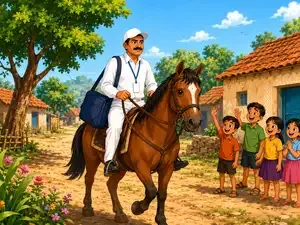
Videos showing Gupta, dressed in a white uniform and government-issued Census cap, riding a brown horse through village roads with survey documents slung over his shoulder, have since spread widely across social media platforms.
According to Gupta, the horse has also helped him access settlements connected only by narrow dirt tracks where motorcycles struggle to pass. “In such places, we can still go house to house on horseback and understand the conditions of every household while preparing the maps,” he said.
Gupta added that horses have long been part of his family tradition and that he learnt riding from his father during childhood. His unusual mode of transport has especially drawn curiosity among children in the villages.
“Children born after 2018 or 2019 mostly know horses from images. They came close, saw the animal directly and became very excited,” he said.
Gupta, who has been teaching since November 25, 2003, said this is his first Census assignment.
“I thought if the Government of India has given me this responsibility, then I should begin immediately and complete it with sincerity,” he said.
The ongoing work involves house-listing and preparation of “nazri naksha”, or sketch maps of households and localities. Gupta said the exercise is likely to continue for around a month, with enumerators covering anywhere between five and 20 houses a day depending on local conditions.
“Sometimes, mobile networks do not work. Sometimes, people are not at home, and we have to revisit the houses later. So, the number of houses covered each day can vary,” he said.
Gupta said people have largely appreciated his decision to use a horse for the assignment.
“People are appreciating it. I only thought about saving fuel and using what was available at home,” he said.
Jharkhand began the first phase of Census 2027 — “House Listing and Housing Census” — on May 16, with the exercise scheduled to continue till June 14. The state government has deployed thousands of enumerators and supervisors for door-to-door surveys, with data being collected digitally through mobile applications for the first time.
Gupta said the horse is usually brought out only during festivals, village ceremonies and religious rituals, but he now intends to continue using it during the Census exercise.
“The survey work may continue for around a month, with enumerators required to visit households repeatedly in areas with poor connectivity or where residents are unavailable. My horse will help me to deal with this fuel crisis in India,” he said.
Munna Prasad Gupta, 43, an assistant teacher at the upgraded government high school (Utkramit Uchha Vidyalay) in Tatidiri village of Dhurki block in Garhwa, said he decided to travel on horseback for house-listing and map-preparation work after struggling to obtain fuel over the past few days.
“Petrol was not easily available, and there were long queues. So, I thought that instead of wasting time in queues, I should come up with an alternative. We have had this horse in our family for years, so I thought I should go on horseback,” Gupta told The Indian Express.
Videos showing Gupta, dressed in a white uniform and government-issued Census cap, riding a brown horse through village roads with survey documents slung over his shoulder, have since spread widely across social media platforms.
According to Gupta, the horse has also helped him access settlements connected only by narrow dirt tracks where motorcycles struggle to pass. “In such places, we can still go house to house on horseback and understand the conditions of every household while preparing the maps,” he said.
Gupta added that horses have long been part of his family tradition and that he learnt riding from his father during childhood. His unusual mode of transport has especially drawn curiosity among children in the villages.
“Children born after 2018 or 2019 mostly know horses from images. They came close, saw the animal directly and became very excited,” he said.
Gupta, who has been teaching since November 25, 2003, said this is his first Census assignment.
Census fieldwork begins
The teacher said he began the fieldwork on Saturday despite it being a school holiday, viewing the Census exercise as an important national responsibility.“I thought if the Government of India has given me this responsibility, then I should begin immediately and complete it with sincerity,” he said.
The ongoing work involves house-listing and preparation of “nazri naksha”, or sketch maps of households and localities. Gupta said the exercise is likely to continue for around a month, with enumerators covering anywhere between five and 20 houses a day depending on local conditions.
“Sometimes, mobile networks do not work. Sometimes, people are not at home, and we have to revisit the houses later. So, the number of houses covered each day can vary,” he said.
Gupta said people have largely appreciated his decision to use a horse for the assignment.
“People are appreciating it. I only thought about saving fuel and using what was available at home,” he said.
Jharkhand began the first phase of Census 2027 — “House Listing and Housing Census” — on May 16, with the exercise scheduled to continue till June 14. The state government has deployed thousands of enumerators and supervisors for door-to-door surveys, with data being collected digitally through mobile applications for the first time.
Gupta said the horse is usually brought out only during festivals, village ceremonies and religious rituals, but he now intends to continue using it during the Census exercise.
“The survey work may continue for around a month, with enumerators required to visit households repeatedly in areas with poor connectivity or where residents are unavailable. My horse will help me to deal with this fuel crisis in India,” he said.