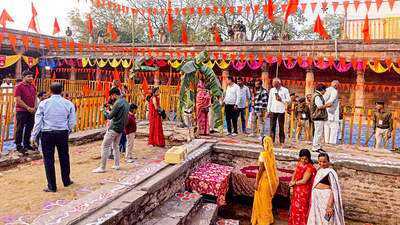
The verdict by the Indore bench of the Madhya Pradesh High Court on 15 May declaring Dhar’s Kamal Maula mosque complex as the Bhojshala Saraswati Temple marks another moment in India’s contest over faith, history and law. In a detailed judgment, the court held that the religious character of the site to be that of a temple dedicated to Goddess Vagdevi (Saraswati), linked to Raja Bhoj of the Paramara dynasty. It granted Hindus unrestricted access while suggesting alternative land for the Muslim community, effectively overriding centuries of use as a mosque.
The structure, built between 1304 and 1331 during the Delhi Sultanate, has long been known as the Kamal Maula mosque, associated with the Sufi saint Kamaluddin Chishti. Muslim worship at the site stretches back nearly 700 years, supported by historical references, revenue records and colonial-era documentation. A 1935 Dhar state court reportedly recognised it as a mosque. Even the Archaeological Survey of India (ASI) treated and protected it as such through much of the 20th century. The term ‘bhojshala’ gained currency only in the early 1900s through colonial officials notably education officer K.K. Lele—decades after earlier British accounts described it simply as a ruined mosque.
Archaeology under scrutiny
The verdict rests heavily on the ASI’s 98-day survey and its 2,000-page report which catalogued architectural fragments, sculptures, inscriptions, and historical references pointing to an 11th-century centre of Sanskrit learning. Yet the process itself has drawn criticism.
Operating under the Union Ministry of Culture without mandatory peer review or independent academic scrutiny, the ASI’s findings were presented in sealed formats to judges who are not archaeologists. This opacity raises concerns about whether the exercise prioritised scientific rigour or delivered a predetermined narrative dressed in the language of evidence. The court proceeded despite these gaps.
The All India Muslim Personal Law Board questioned the report’s repeated use of ‘Bhojshala temple’ as an established fact rather than a disputed claim. Critics also flagged incomplete videography, absence of court-directed carbon dating, and the selective treatment of evidence that suggested a more layered history.
The larger concern lies in the legal route adopted. The judgment sidesteps the spirit of the Places of Worship Act, 1991, by invoking the exemption for protected monuments under Section 4(3). The law was enacted to freeze the religious character of places of worship, as they stood on 15 August 1947, and prevent precisely such disputes from proliferating after Ayodhya. The monument’s exception, however, is increasingly being used to reopen claims at historically sensitive sites.
The parallels with the 2019 Babri Masjid verdict are difficult to ignore. A five-judge bench headed by then Chief Justice Ranjan Gogoi awarded the site to Hindu litigants (Ram Lalla Virajman) citing faith, archaeological indications of a prior structure, and possession, while allotting alternative land for a mosque. In both cases, archaeological interpretation, assertions of historical faith and judicial balancing converged in favour of Hindu claimants. The pattern raises troubling questions about the role of institutions meant to mediate such conflicts impartially.
A replicable template
The Bhojshala verdict may not remain confined to Dhar. Similar claims are already surfacing elsewhere, including at Vidisha’s Bijamandal mosque. What is emerging is not merely a series of local disputes, but a replicable legal and political template.
India’s constitutional promise demands greater institutional restraint. Archaeology must be transparent and independently scrutinised. Courts must remain attentive not only to faith and antiquity, but also to the constitutional commitment to equality and pluralism. In disputes so deeply tied to identity and memory, selective readings of history can deepen division rather than deliver justice.
The Kamal Maula mosque-Bhojshala complex now stands under temple administration. The AIMPLB and others plan to challenge the verdict in the Supreme Court.
Whether the apex court will insist on evidentiary robustness and the spirit of secular safeguards remains to be seen.
—Hasnain Naqvi is a former member of the history faculty at St Xavier’s College, Mumbai
Making room for the other’s faith-
'Nervous' Princess Kate's behind the scenes admission to Mary Berry after major move

-
Premier League team left in limbo by Southampton Spygate scandal after £20m demand

-
Strictly bosses made a big mistake with one new host - and it's not Emma Willis

-
5 subtle hints Emma Willis was always going to be new Strictly Come Dancing host
-
UK charity shop giant confirms 45 stores to close - two before end of May