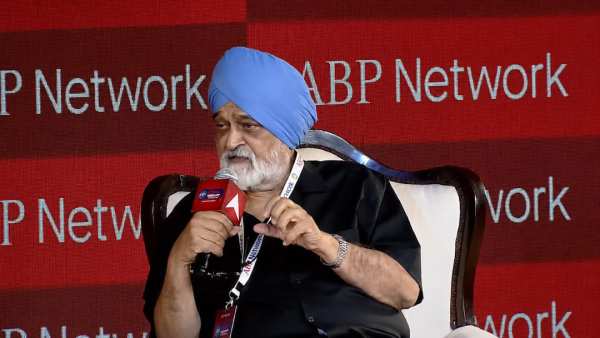
Former Deputy Chairman of the Planning Commission Montek Singh Ahluwalia on Wednesday warned that India is entering a period of serious macroeconomic stress.
Speaking at ABP Network's India@2047 Conclave for a session titled Reviving PPP: Reimagining Infrastructure Financing, he said the country must now manage a widening current account deficit with far less foreign capital coming in than before.
What Is Happening To India's External Accounts
Ahluwalia said India has, for the last several years, run a current account deficit of around 1.5 per cent of GDP. This was manageable because foreign capital flows, including direct investment and portfolio flows, were generating a capital account surplus of roughly 2 per cent of GDP.
That balance is now shifting. The ongoing crisis, he said, is likely to push the current account deficit up to around 2.2 per cent of GDP due to higher import bills for oil and fertiliser. At the same time, the capital account surplus is falling from about 2 per cent to nearly zero.
The reason, he explained, is that high interest rates in the United States are pulling global investors back toward American assets. "Money flows back to the US. Very unfair because the US economy has a lot of longer-term problems, but that's what happens in the short run," Ahluwalia said.
Oil At $95 A Barrel Through the Year
Ahluwalia said he expects oil prices to stay at an elevated level of around $95 per barrel through the end of 2026. He attributed the current relative stability to major countries drawing down their strategic reserves. Once the situation normalises, rebuilding those reserves will itself drive fresh demand and keep prices high, he said.
He was careful to flag uncertainty around geopolitical developments. "If my forecasting skills extended to being able to predict what President Trump says or does, I would be a lot richer than I am," he said.
How Should India Respond
With a current account deficit of roughly $60 to $70 billion and little to no capital account surplus available, Ahluwalia outlined India's options. One, he said, is to allow foreign exchange reserves to fall. If policymakers are confident that oil prices will normalise within eight or nine months, letting reserves decline while protecting the rupee could be a reasonable short-term approach.
But he was clear that the deeper solution lies in reducing aggregate demand across the economy. "Macroeconomics will tell you that to do that you just have to reduce aggregate demand. You don't do that by banning this import and stopping that import," he said, dismissing the approach used in the 1970s as outdated.
Targeted Support Instead Of Fuel Subsidies
Ahluwalia pushed back firmly against blanket fuel subsidies. He said petroleum is not a product that deserves government support. If rising fuel prices are hurting poor households, the right response is to increase direct income transfers to them, not to hold down petrol prices for everyone.
"If a very poor person is going to be hit by the rise in petroleum prices, it is better to increase the general transfer to poorer people," he said. "It is better to increase the kind of schemes that will give them more income rather than keep the petrol price for everybody, including those who drive Mercedes."
He drew a distinction between petroleum and essential medicines, saying the latter are a legitimate candidate for subsidies.
-
Cooking Tips: Don’t make the mistake of doing ‘these’ things when cooking in a clay pot for the first time, or else…

-
Celebrity Fashion: From Alia to Deepika, these actresses made repeat outfits a style statement

-
Laptop Screen : Big mistake while cleaning laptop screen? Using eyeglass cleaners can be dangerous

-
Maruti introduced the country’s first flex fuel car, this is its big feature

-
The feature that everyone was waiting for has arrived on WhatsApp! Now you can edit your status even after posting it