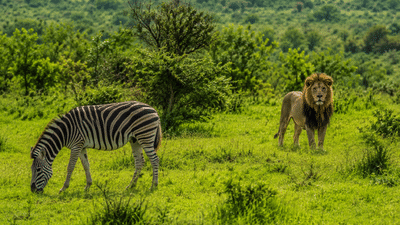
The way we see the world often depends on where we stand. What appears heroic to one person may seem harmful to another, and the same event can have entirely different meanings depending on who experiences it. The thought-provoking saying, "If you ask the grass, the zebra is the monster and the lion is the protector," challenges us to question our assumptions about right and wrong. Instead of judging situations from a single point of view, it encourages us to recognise that every story has multiple perspectives , each shaped by its own interests and experiences.
Although the Proverb has no widely accepted historical source and is often shared as a modern philosophical saying, its message echoes a timeless truth found across cultures: reality is rarely as simple as it first appears.
Proverb of the day
"If you ask the grass, the zebra is the monster and the lion is the protector"
What does this Proverb mean?
The Proverb teaches that our understanding of events is influenced by perspective . While people naturally sympathise with the zebra because it is hunted by the lion, the grass experiences the situation differently. From the grass's point of view, the zebra consumes it every day, while the lion helps preserve it by controlling the zebra's population. The saying reminds us that labels such as "hero" and "villain" often depend on whose story is being told.
Every perspective reveals only part of the truth
In everyday life, disagreements often arise because people view the same situation through different experiences. A manager and an employee may see the same workplace decision differently. Parents and children may interpret rules in contrasting ways. Even historical events can be understood differently depending on culture, geography or personal experience. The Proverb encourages us to pause before reaching conclusions and consider viewpoints beyond our own.
Nature reminds us that balance matters
The proverb draws its power from the natural world, where survival depends on balance rather than simple ideas of good and evil. Lions hunt to survive, zebras graze to live, and grass grows as part of the same ecosystem. None of them acts out of malice; each fulfils its role in maintaining nature's delicate balance. Likewise, many human conflicts cannot be understood by looking at only one side. Appreciating the wider picture often leads to wiser and fairer judgments.
Empathy begins with listening
One of the greatest challenges in modern society is the tendency to form opinions before understanding the experiences of others. Whether in personal relationships, workplaces or public debates, listening to different perspectives often reveals complexities that first impressions overlook. This Proverb reminds us that empathy is not about agreeing with everyone; it is about recognising that our own viewpoint may not be the only valid one.
Why does this Proverb still matter today
In an era of social media, polarised opinions and instant judgments, this saying feels especially relevant. People are often encouraged to choose sides without fully understanding the circumstances behind an issue. The Proverb reminds us that truth is rarely one-dimensional and that thoughtful decisions require curiosity, humility and the willingness to see beyond our own experiences. Sometimes, the wisest response is not asking who is right, but asking whose perspective has yet to be heard.
-
Inside Thomas Tuchel and Jude Bellingham’s Dynamic at the Core of England’s World Cup Campaign

-
Why Manchester United Might Find Manu Koné a Better Midfield Fit Than Ederson

-
Why Lionel Messi Has Never Played Against England Before as World Cup Semi-Final Awaits

-
Arsenal racing to finalise swift transfer for Argentina’s World Cup hero Julian Alvarez

-
David Beckham sings ‘Wonderwall’ with sons Romeo and Cruz as England celebrate special World Cup win, while Victoria opts out of Oasis tribute