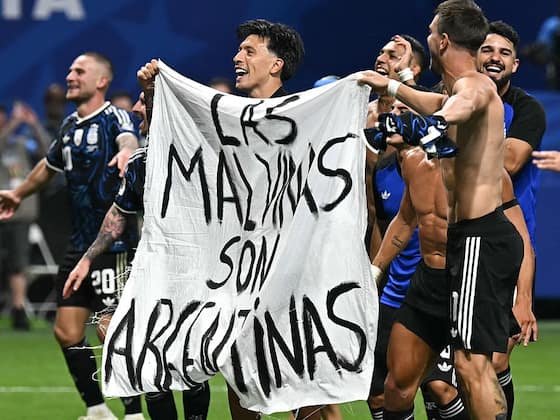
Downing Street reaffirmed Britain's unwavering support for the Falkland Islands following growing controversy over Argentina players displaying a provocative banner after their 2-1 win against England in the World Cup semi-final.
Prime Minister Sir Keir Starmer strongly condemned the Argentine team members who held up a banner referencing the Falklands dispute during post-match celebrations in Atlanta, Georgia. The Prime Minister’s official spokeswoman stated, “The World Cup might not be ours, but the Falkland Islands certainly are. Our position remains unchanged. The right to self-determination lies with the islanders, and our commitment to the Falklands will never waver.”
Argentina’s players were seen holding a banner that read “Las Malvinas son Argentinas” (“The Falkland Islands are Argentinian”), sparking outrage in the UK. Cabinet minister Peter Kyle labelled the act “undignified” and urged FIFA to conduct a thorough investigation, calling it an “egregious violation” of tournament regulations.
Liberal Democrat leader Sir Ed Davey went further, demanding that the players involved be suspended from the upcoming World Cup final. The incident occurred after Argentina’s 2-1 victory over England, with jubilant fans near the pitch also waving similar banners.
Under Article 34.3 of FIFA’s tournament rules, players are strictly prohibited from displaying political messages or slogans before, during, or after matches. The Argentine Football Association and the players involved now face possible disciplinary action.
Business Secretary Peter Kyle told BBC Breakfast, “My reaction is that it was completely inappropriate. Politics must remain separate from football. One of the World Cup’s core principles is precisely that separation.”
Following the incident, several British politicians called for Argentinian players based in the UK to have their visas revoked if they were involved in the protest. Members of Argentina’s squad currently play for top Premier League clubs — Lisandro Martínez of Manchester United, Cristian Romero of Tottenham Hotspur, Alexis Mac Allister of Liverpool, Emiliano Martínez of Aston Villa, and Enzo Fernández of Chelsea.
Lisandro Martínez and former Tottenham star Giovani Lo Celso were among those photographed holding the banner and smiling as they waved to fans.
Meanwhile, diplomatic tensions deepened as Argentina lodged a formal protest with the UK, accusing Britain of an “unlawful” naval manoeuvre near the Falkland Islands. The Argentine foreign ministry, led by Pablo Quirno, issued a statement expressing its “strongest rejection” of HMS Medway’s recent movements, describing them as a “military incursion.”
Downing Street dismissed the allegation, confirming that Argentina had been notified in advance of HMS Medway’s routine logistics visit to Chile between 5 and 8 July to support British Antarctic survey operations. “The Royal Navy always operates in full compliance with international law,” a No.10 spokeswoman said. “The route taken from the Falkland Islands to Chile was the most direct and practical, considering safety and weather conditions.”
Before the semi-final, Argentina’s head coach Lionel Scaloni had publicly urged for the match not to be politicised. However, following the win, Argentina’s vice president Victoria Villarruel posted a message declaring “it wasn’t just another match,” accompanied by footage appearing to show Argentine soldiers. She had previously referred to England as “invaders” and “usurping pirates.”
UK Conservative leader Kemi Badenoch responded to the banner incident by asserting, “The Falkland Islands are British. The Conservatives will always defend them.” Former party leader Sir Iain Duncan Smith called for FIFA to issue fines, stating, “It’s extremely inflammatory. We went to war to defend the islanders’ rights, and there must be some form of punishment.”
Reform UK leader Nigel Farage also weighed in, saying, “While we are appalled by the behaviour of certain Argentinian players, the most important thing now is to strengthen the Royal Navy swiftly.”
The Falklands dispute remains a deeply sensitive issue four decades after the 1982 conflict, in which British forces reclaimed the islands following Argentina’s invasion. Despite repeated claims of sovereignty by Buenos Aires, the Falkland Islands continue to be a British Overseas Territory, located around 8,000 miles from the UK and roughly 300 miles from Argentina’s mainland.
-
Robert Lewandowski reveals his deep connection with Barcelona led him to reject European offers before opting for Chicago Fire move
-
Arsenal Finalise £34m Deal for Christos Tzolis from Club Brugge as Mikel Arteta Strengthens Attack

-
Why international students choose to get vaccinated in Vietnam

-
Diljit Dosanjh accepted one rupee for Sutlej role

-
3 Zodiac Signs Attract Major Financial Success On July 17, 2026