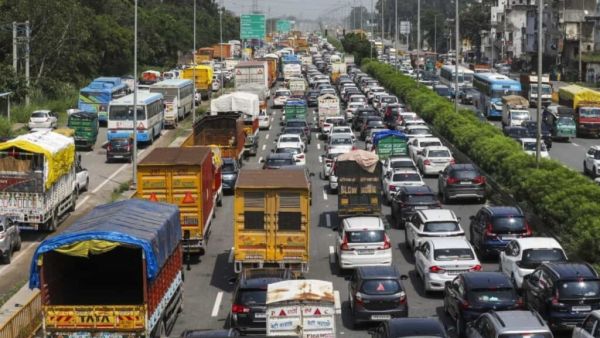
Automobile Desk: Infrastructure in India has developed very rapidly in the last few years. Today, a network of world-class expressways and gleaming national highways has been spread in many parts of the country, which has reduced long journeys of hours into minutes. However, during a long distance journey, every driver must have noticed one thing that the speed limit of vehicles keeps changing continuously on the same route or on different roads. At some places, cars are allowed to run at a speed of 120 kilometers per hour, while at other places this limit is reduced to 100 or 80 kilometers per hour.
Drivers often think that this difference in speed limit is done only to issue challan or to make traffic rules stricter. But in reality, a very deep scientific, engineering and safety mathematics works behind determining the maximum speed of vehicles on any road. The government or the traffic police do not set this limit as per their wish, rather the road map, the design of the vehicles and the safety of the drivers are the main reasons behind it.
The first and foremost factor in deciding the speed limit is the design of the road. Expressways like Delhi-Mumbai or Purvanchal are made 'Access Controlled'. This means that no vehicle, pedestrian or cattle can suddenly enter these roads from anywhere. There are fixed entry and exit points for boarding and deboarding. In contrast, normal national or state highways pass through many towns, villages and intersections. There is always a risk of side roads, cuts and sudden traffic on these routes. For this reason, to prevent accidents, the speed limit on highways is kept lower than that on expressways.
The second major reason is to the bend, slope and visibility of the road. Whenever civil engineers design an expressway, the turns are kept very long and straight so that the driver can clearly see the distance. Apart from this, to maintain the balance of vehicles at high speed, the road is slightly inclined at the turns, which in technical language is called 'camber' or 'banking'. On the other hand, on old highways or mountain roads, the turns are very sharp. If the vehicle is traveling at a speed of 120 km/h on such turns, the risk of it overturning or becoming uncontrollable increases manifold as soon as the brakes are applied. That is why speed limit boards are reduced near sensitive parts and turns.
Also, this speed limit does not just depend on the road, but also on the type of vehicle you are driving. According to the rules of the Ministry of Road Transport of India (MoRTH), 120 km/h is allowed for passenger cars on expressways, but this limit does not exceed 80 km/h for heavy vehicles like buses and trucks. The main reason behind this is 'Stopping Distance' and 'Momentum'. Due to heavy vehicles being heavier, they require more distance and time to stop in an emergency.
Finally, the number of lanes on the road and the effect of weather also determine the speed. Speeding is considered safe in areas with more lanes and controlled traffic. During the rainy season, at high speeds, the friction between the tire and the road gets lost, which is called 'aquaplaning'. In such a situation, the vehicle starts floating on water and control is lost from the steering. Therefore, speed limit signboards installed on the roadside are not just rules, but safety standards alerting drivers to the potential dangers of that particular road section.
-
5 Simple Kitchen Remedies To Keep Ants Out Of Your Home

-
Raksha Bandhan 2026: Special preference for 'Eco-friendly' Rakshas! Tie a rakhi and plant a tree', what is the special activity?

-
If there should be a brother! BoAt-Blinkit's Amazing Digital Campaign for Rakshabandhan, Arbaaz Khan Tells Fund to Be 'Achcha Bhaiya'!

-
Manchester United signs Carlos Baleba from Brighton until 2031

-
Premier League 2026-27 Points Table: Arsenal Start Title Defence in 2nd, Tottenham Crash Into Relegation Zone After Matchday 1