When Acura arrived in 1986, it genuinely felt new—an upmarket marque from a Japanese carmaker. Honda had got there roughly four years ahead of both Toyota and Nissan. The two models that launched Acura—the compact Integra and the larger Legend—were clearly premium offerings. The Integra was essentially a more sophisticated Civic with a flashy twin-cam, 16-valve engine, while the Legend was a big saloon powered by a V-6 so silky-smooth it felt as though it had been lubricated with cholesterol. Acura stood apart, was instantly aspirational, and undeniably cool.
Now, 40 years later, that is no longer quite the case.
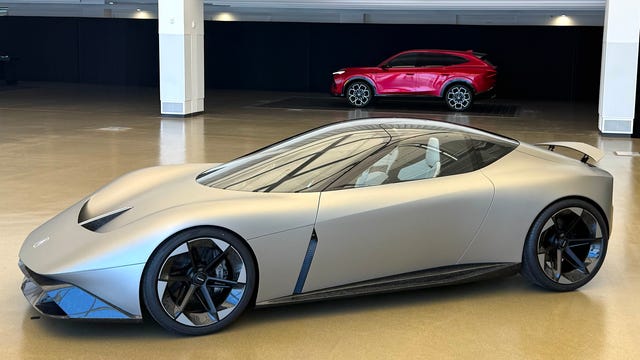
The Nexera Vision concept, which makes its debut on Thursday, is Acura’s latest thematic attempt to reinvent itself. It does not directly preview any upcoming production vehicle, but the brand’s new creative director and vice president of auto design, Yasutake Tsuchida, says it is “serving as the design language for future Acura models.”
Acura will first show the Nexera Vision in person at The Quail, a Motorsports Gathering this Friday, August 14, as California’s Monterey Car Week heads into the weekend. Unfortunately, it is not a sign of an NSX revival. At a preview event at Honda’s headquarters in Torrance, Acura displayed the Nexera Vision to a group of journalists alongside a clay model of an upcoming hybrid SUV—and if that SUV is not the next RDX, then all the speculation will have been wasted. The SUV had already been shown back in May, so there were no real surprises on that front.
“We’re the first Japanese luxury company in America,” Tsuchida said, “and we’ve always sold in North America, but the design language is still rooted in our Japanese culture.” Even so, the design work itself comes from Acura’s Los Angeles studio.
Finished in a velvety silver shade called “Matte Titanium”—though in reality it looks closer to an almost satin-like finish—the Nexera sits with its nose nearly skimming the road, and its front end opens with nostril-like elements that seem unconcerned with cooling any powertrain. It has the sort of attitude Acura needs to build on. One styling cue almost certain to reach production is the use of Acura’s “A-Mark,” made up of grouped pointed triangles. The Nexera applies those A-Marks at all four corners of the vehicle, and that will become a signature element on future Acuras.
Some other design touches feel familiar, while others are more understated. The “dual-hinge butterfly” doors are reminiscent of Lamborghini-style theatrics, while the proportions carry a kind of sensual languor—sensual in the dramatic sweep of the huge windscreen, and languid in the long wheelbase that stretches even farther forward than the leading edge of that enormous glass panel. At the rear there is an active-aero spoiler, although this concept is unlikely ever to be tested at the sort of speed where it would actually make a difference.
One of the more interesting parts of the design is its use of “forged carbon” trim pieces created through a compression-moulding process. However, the concept does not use carbon fibre as a structural material.
Inside, the presentation is more fanciful. The seats are moulded into the floor and fixed in place so that the driver and passenger sit very low, helping lower the theoretical centre of gravity even further. The instrumentation is presented as one sweeping digital display, and steering duties are handled by a yoke.
There is very little in the way of information about the Nexera’s powerplant or drivetrain. So readers are free to speculate—or not. Either approach works.
Just across from the Nexera Vision sits a clay model of what is, with more than a hint, the upcoming RDX Hybrid. It features the first application of Acura’s soon-to-be widespread A-Mark tail-lights, and it comes across as a handsome, muscular SUV that appears larger than the previous three generations of the RDX. It also clearly departs from current Acura design themes, replacing the large diamond-shaped front grille with a heavily sculpted fascia that mixes gloss black and body-colour elements. It looks modern and neatly tailored, with pronounced rear haunches and a proud tail section.
No details were provided—including any direct acknowledgement that this is in fact the next RDX. Beyond that, Acura did confirm that the SUV is a hybrid. With some luck, the hybrid drivetrain will prove as sweet and appealing as the turbocharged K-Series 2.0-litre four-cylinder used in the third-generation RDX. There is also no charging flap visible on the model, which likely means it is not a plug-in hybrid.
Interestingly, Acura will begin selling the Integra Type S—built in America and still left-hand drive—in Japan later this year. The Type S was a Road & Track Performance Car of the Year contender in 2024, and it remains a favourite among the staff. If Japan takes to it, perhaps that will encourage Honda to bring some of that car’s confident audacity and athletic character to future Acura models across the board.
The world does not need another Lexus; it needs an authentically bold Acura that carries forward Honda’s tradition of outstanding mechanical engagement. The hope is that the design themes introduced by the Nexera Vision will help the company express exactly that.
-
Municipality's Vaidya AI chatbot for health care! Treatment information will be available along with hospital available near home

-
Rakshabandhan: Unique stories of brother-sister relationship

-
Kanye West calls Yeezy ‘the Apple of clothing’ after sellout
-
Yes, Harbor Freight Does Sell Replacement Parts
-
Afghanistan announces squad for Asian Games 2026; The captaincy was entrusted to 'this' player