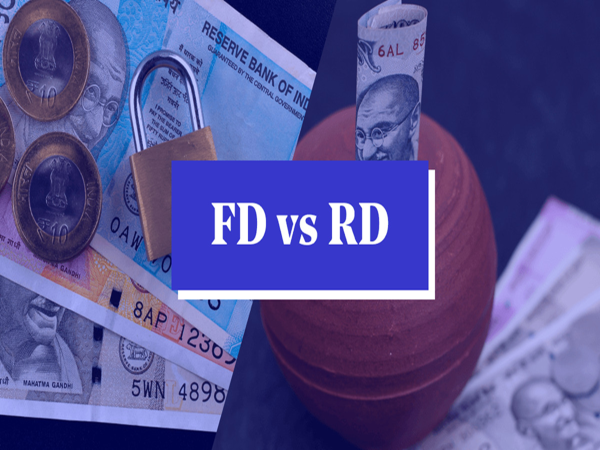
Investing in banks is a highly popular practice that has been around for years. People typically invest in either Fixed Deposits (FDs) or Recurring Deposits (RDs). With an FD, a lump sum is locked in with a bank or post office for a specific period, earning interest on that amount. In contrast, an RD involves making small, regular monthly investments.
But have you ever wondered why the returns differ even when the average interest rates for both are the same? If so, this article is for you. Let’s explore both investment methods in detail and use calculations to understand which one offers higher returns.
1. How are funds deposited in FDs and RDs?
In an FD, a large lump sum is invested for a fixed tenure, and interest begins to accrue from day one. FD tenures can range from a minimum of 7 days to a maximum of 30 years. With an RD, however, you invest a small amount each month, and interest starts accruing on those deposits.
2. How is interest calculated?
Since interest on an FD starts accruing from the very first day, the returns tend to be higher. Conversely, because RD deposits are made in smaller installments over time, the total return is generally lower.
3. What is the return over 5 years?
Let’s assume an annual interest rate of 6.5%. If you invest a lump sum of ₹1 lakh in an FD for 5 years, you would receive approximately ₹1,38,042. In contrast, depositing ₹1,666 per month (totaling ₹1 lakh) into an RD over 5 years would yield approximately ₹1,18,270. This means the FD offers a benefit of about ₹19,772 more.
4. Which option is better for you?
Both investment methods are excellent, but you should choose based on your specific needs. If you have a lump sum available and do not require the funds in the near future, investing in an FD is a good option. On the other hand, if you do not have a large amount of money, you can invest in a Recurring Deposit (RD); this allows you to save monthly and accumulate a substantial sum over a few years.
5. Where is the relief on the tax front?
Generally speaking, the returns generated through both methods are subject to taxation. Furthermore, if the interest earned exceeds a certain limit, the bank may deduct TDS.
Disclaimer: This content has been sourced and edited from Dainik Jagran. While we have made modifications for clarity and presentation, the original content belongs to its respective authors and website. We do not claim ownership of the content.
-
DA Hike News: Will the Dearness Allowance hike be announced on Raksha Bandhan? Expert makes a major demand..

-
FD vs Gold: Which investment option is safer, and what returns have they yielded over 20 years? Everything in 5 points..
-
EPFO: These 4 mistakes can stop interest payments into your PF account! EPFO itself explains when an account becomes 'inactive'..

-
Meta accused of compromising children's safety; safety tools deliberately designed to be weak..

-
Neeraj Chopra Throws Season Best But Loses Again To Sri Lankan Fast Bowler By 9cm