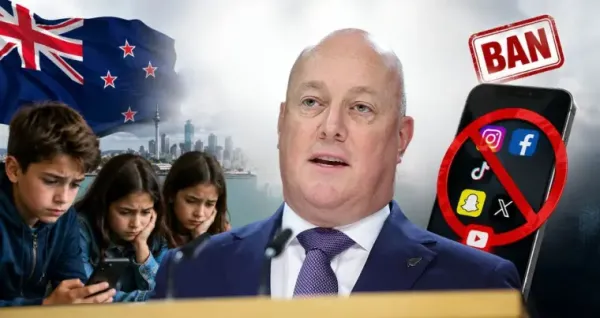
New Zealand has taken a big step regarding the online safety and mental health of children. Prime Minister Christopher Luxon’s National Party has introduced a bill in Parliament, which proposes to ban the use of social media by children under 16 years of age.
New Zealand social media restrictions: The New Zealand government is preparing to ban the use of social media by children under 16 years of age. Prime Minister Christopher Luxon’s government is going to introduce a new bill in this regard in Parliament. The proposed law aims to protect children from harmful content on social media, online pressure and addictive technologies of the platforms. However, this proposal of the government is facing opposition from the coalition partner New Zealand First Party.
If this bill becomes law, it will be the responsibility of social media companies to check the age of people using their platforms. A provision for heavy financial penalty against companies that do not follow the rules has also been kept in the proposal.
There will be a ban on children under 16 years of age
Under the proposed law, children under 16 years of age will be prevented from using social media platforms. The government says that it has become necessary to take strict steps to protect young children from the many risks present in the online world. Prime Minister Christopher Luxon has cited the safety of children as the main reason for this initiative. He says that the government cannot close its eyes to the harm caused by social media to an entire generation of children.
According to the government, constant presence on social media can have a negative impact on children’s sleep, studies, family relationships and mental health. Additionally, underage users may be exposed to harmful content and technologies designed to keep them on the platform for longer periods of time.
Social media companies will have to verify age
The most important part of the new rules is to age verification. Social media companies will have to take appropriate technical measures to ensure that no child under 16 years of age can use the restricted platform. In the proposed system, different techniques can be used to confirm age. These may include existing account information, digital identity documents and, in some circumstances, technologies such as facial recognition.
However, questions to privacy and security of personal data may also arise regarding age verification. The challenge before the government will be how to ensure the safety of children as well as protect the personal information of users.
Heavy fine on companies for breaking rules
The New Zealand government is also preparing to make social media companies financially accountable for following the rules. Under the proposed law, companies that commit serious violations could be fined up to 10 percent of their global revenue. Such a huge potential fine could put pressure on social media companies to seriously enforce age verification and child protection measures.
However, the government also faces the challenge of getting the bill passed by Parliament. Prime Minister Luxon’s coalition partner New Zealand First Party has refused to support the proposed social media ban. Party leader and Foreign Minister Winston Peters has expressed serious concerns about the proposal. He believes that there is a need to be cautious about the government’s role in controlling children’s social media use.
Peters also cited the experience of Australia, where a ban on social media has been implemented for children under 16. He refused to accept Australia’s system as an effective model and emphasized the importance of parents’ role in responsibility for children’s online activities.
New Zealand’s initiative after Australia
Australia had taken one of the world’s strictest steps towards implementing a ban on social media use by children under 16 in 2025. After this, the demand for a similar law intensified in New Zealand also. Prime Minister Luxon has acknowledged that implementing such a ban will not be easy. Some children may find ways to avoid the rules, but the government believes that even if it is difficult, it is important to make efforts to protect children online.
-
MVP Power Rankings: Who can push Lionel Messi and Evander all the way?
-
Uttar Pradesh: Mahayogi Gorakhnath University Completes 5 Years, Offers 53 Employment-Oriented Courses
-
Bryan Robson identifies Lewis Hall as ideal next signing after Carlos Baleba, but raises FFP concern

-
Not only wingers? Andoni Iraola makes Liverpool transfer admission with only days left

-
Tottenham Hotspur sign Omar Marmoush on loan