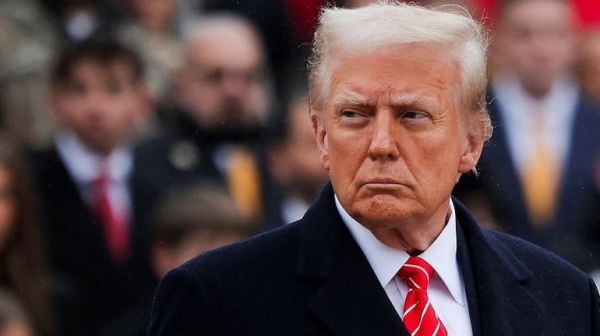
The ongoing military tension between America and Iran has now reached its most decisive and dangerous point. US President Donald Trump, while addressing reporters at the White House, has given a sensational statement that the United States may very soon launch a precise and severe attack on Iran's highly secure underground nuclear base 'Pickaxe Mountain'. Trump warned in strong words that America's space technology and the US Space Force are keeping a close watch on this entire area round the clock. He bluntly said that Washington has accurate information about every activity and movement of every vehicle taking place in Pickaxe Mountain and throughout Iran. Trump made it clear that if the situation worsens, America will attack there very strongly. This statement has come at a time when tensions are at its peak in the Middle East over missile attacks, drone confrontations and movement of ships in the Persian Gulf. This direct threat by Trump has created a stir in global diplomatic circles and the International Atomic Energy Agency (IAEA). Defense experts believe that if America directly targets this underground nuclear base, it could prove to be a direct declaration of full war, unlike the sporadic attacks so far. What is Pickaxe Mountain? Iran's impenetrable nuclear fort, hidden 140 meters below in the Zagros hills, known as 'Pickaxe Mountain' in the international media and intelligence agencies, is actually located in Isfahan, the central province of Iran. In the Persian language this mountain is called 'Kūh-e Kolang' or its full name is 'Kolang Gaz Lā', which literally translates to Spade or Pickaxe Mountain. Officially, Iran also calls it 'Shaheed Alimohammadi Complex'. Geographically, this giant mountain is located just 1.5 to 2 kilometers south of Iran's infamous Natanz uranium enrichment plant and falls about 220 kilometers south of the capital Tehran. The biggest feature of this mountain is its geological structure. While most of the surrounding Zagros mountain range is made of sedimentary rocks, Pickaxe Mountain is made of extremely solid, hard and dense igneous granite stones. This mountain is located at an altitude of about 1,608 meters above sea level, which is almost twice as high as the mountain where Iran's Fordow nuclear plant is located. According to satellite analyzes and geological studies, Iran has cut this hard granite rock and created two huge underground tunnel complexes and halls at an extreme depth of 100 to 140 meters below the mountain peak. To reach this complex, massive tunnel portals covered with thick layers of strong concrete and soil have been built on the east and west sides. Secret construction started after the mysterious explosion of 2020: Why is this place safer than Natanz? The story of the formation of Pickaxe Mountain is linked to a large secret explosion that occurred at Natanz in July 2020. On July 2, 2020, a mysterious sabotage incident took place in the modern centrifuge assembly workshop built on the ground just above the main enrichment center of Natanz, behind which the Israeli intelligence agency Mossad was believed to be behind. Iran's advanced centrifuge manufacturing workshop was completely destroyed in this explosion. Soon after this major failure, Ali Akbar Salehi, the then head of the Atomic Energy Organization of Iran (AEOI), publicly announced in front of the National Security Committee of the Iranian Parliament that Tehran would now install its modern centrifuge assembly unit inside 'by cutting the chest of the mountains' to protect it from any air attack or sabotage. After this, heavy drilling and excavation work was started in Pickaxe Mountain in the end of the year 2020. Iran's official stance has always been that the site is being built only for the manufacturing and assembly of thousands of advanced centrifuge machines (such as IR-4 and IR-6). However, to date, inspectors from the International Atomic Energy Agency (IAEA) have not been allowed to go inside the base and conduct an independent investigation. Western and Israeli intelligence agencies believe that due to the continuous cyber attacks and airstrikes on Natanz, Iran has shifted its secret reserves of Highly Enriched Uranium and Critical Centrifuge Cascades to the abyssal depths of this mountain so that its nuclear weapons program can survive in the event of any war. Bunker buster bomb also ineffective? Will the American GBU-57 be able to penetrate this rocky wall of granite? The biggest military and strategic question arising regarding Pickaxe Mountain is whether even the world's most powerful Air Force can destroy it completely? The heaviest and most destructive non-nuclear-grade bomb in the US arsenal is the GBU-57 Massive Ordnance Penetrator (MOP). Weighing 30,000 pounds (about 14,000 kilograms), this GPS-guided bunker buster bomb is dropped exclusively by America's B-2 Spirit stealth bombers. According to US Air Force tests, the GBU-57 is capable of penetrating approximately 60 meters of normal soil and rock or approximately 8 meters of reinforced concrete. But Pickaxe Mountain's main laboratories and enrichment halls are buried under 100 to 140 meters of solid granite. Military weapons experts believe that no conventional bunker buster bomb in the world can single-handedly break the layer of natural granite present at such a depth. Another option for US military planners could be a 'multi-wave strike', where the upper layers of rock are gradually removed by dropping multiple bunker busters at the same exact coordinates. Additionally, the main focus of the US attack may have been to cut off lifelines inside the mountain rather than directly blowing it up. Pickaxe Mountain's tunnel entrances, external ventilation shafts, power supply grid and security corridor connecting to Natanz could be reduced to rubble by heavy aerial bombardment. If this happens, the scientific and sensitive machines present inside the mountain will be buried under the debris for weeks and the entire plant will become completely inoperable even without breaking completely. Space Force and Satellite Surveillance: The game of uranium enrichment and advanced centrifuges The American Space Force and satellite surveillance mentioned by Donald Trump in his statement is very important. State-of-the-art commercial and military spy satellites such as Planet Labs, Maxar, and the Pentagon's Synthetic Aperture Radar (SAR) satellites have captured every movement of Pickaxe Mountain for decades. The latest satellite images from 2025 and 2026 show that Iran has deployed kilometer-long double security walls, concrete patrol routes and sophisticated surface-to-air missile systems around the mountain. According to intelligence reports, hundreds of containers have been transported into the tunnels of this mountain using heavy trucks in the last few months. Israeli intelligence sources claim that a large part of Iran's approximately 900 pounds of uranium enriched to 60% may be hidden in secure bunkers in this mountain. This uranium is at a stage of enrichment where it can be converted to weapons-grade (90% purity) in a matter of weeks. This is why America, Britain, France and Germany (E3 group) are pressurizing through the United Nations Nuclear Monitoring Agency (IAEA) to send Iran to the Security Council and impose new stringent global sanctions on it. On the other hand, Mehdi Mohammadi, advisor to Iran's parliamentary speaker and Tehran's top military commanders have warned that Pickaxe Mountain is the safest nuclear structure in the world, and if Parinda tries to hit it, Iran will turn the entire area into 'hell'. Threat of Great War in the Middle East: Strait of Hormuz, Oil Crisis and Impact on Global Economy If America attacks Pickaxe Mountain, its impact will not be limited only to the border of Iran, but the entire world will have to pay its economic and strategic price. Iran has already indicated that in the event of any direct attack it could block the Strait of Hormuz, through which about 20 percent of the world's crude oil passes. Although Trump has claimed that America has removed the sea mines laid by Iran and the dependence on Hormuz is reducing after the construction of new oil pipelines in the Middle East, but the ground reality is that as soon as the flow of oil from the Gulf is disrupted, the prices of crude oil in the international market may cross 100 to 120 dollars per barrel. Due to deepening of the energy crisis, inflation will increase in countries around the world and a huge decline will be seen in the stock markets. Along with this, Iran-backed fighters operating in Iraq, Syria, Yemen and Lebanon can intensify attacks on American military bases and commercial ships with suicide drones and ballistic missiles. Trump's latest warning on Pickaxe Mountain has made it clear that the scope for diplomacy regarding Iran's nuclear program is almost over. This nuclear war going on beneath the granite rocks has brought the world to the brink of a new and devastating world war.
-
Ousmane Dembele says Ballon d'Or is likely to remain with a PSG player

-
Manchester City XI vs Porto: Predicted line-up, confirmed team news and injury latest for Champions League clash today

-
WhatsApp To Stop Working On Several Android Smartphones From Today: Check If Your Device Is On The List

-
Indore's Devi Ahilya University Offers 100% Tuition Fee Waiver To Former Agniveers Across Nearly 200 Courses
-
UGC NET 2026: NTA Issues Travel Advisory For Delhi Candidates Appearing On September 9 & 10 Ahead Of BRICS Summit