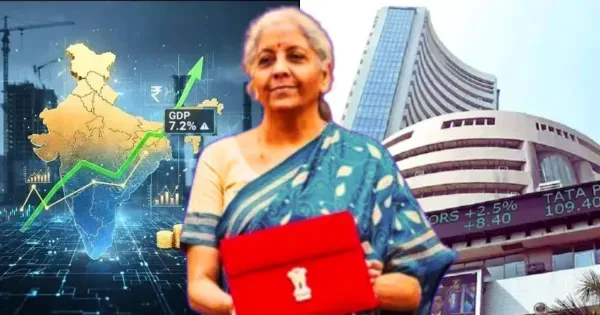
Mumbai. Sensex and Nifty rose after the presentation of the economic review in Parliament on Thursday. The Economic Survey estimates GDP growth to be in the range of 6.8-7.2 percent for the financial year 2026-27. Recovering from all initial losses, BSE Sensex rose 268.58 points to reach 82,613.26. Whereas NSE Nifty was trading at 25,431.40 points with a gain of 88.65 points.
Shares of Tata Steel, Axis Bank, NTPC, Eternal, Adani Ports and State Bank of India were among the gainers. However, shares of Asian Paints, Mahindra & Mahindra, Bharat Electronics and Maruti declined. In Asian markets, South Korea’s Kospi, Japan’s Nikkei 225, China’s SSE Composite and Hong Kong’s Hang Seng were in the lead.
US markets closed stable on Wednesday. The price of international standard Brent crude stood at $ 69.32 per barrel with an increase of 1.27 percent. According to stock market data, foreign institutional investors (FIIs) remained buyers on Wednesday after a long time and bought shares worth a net Rs 480.26 crore. Domestic institutional investors (DIIs) also bought shares worth Rs 3,360.59.
Government on track to achieve fiscal deficit target of 4.4 percent
Delhi. The central government is making good progress in limiting the fiscal deficit to 4.4 percent of the gross domestic product (GDP) in the current financial year. This was said in the Economic Review 2025-26 presented in Parliament on Thursday. The Economic Survey said that the central government balanced both fiscal discipline and sustainable investment for growth, which makes its fiscal path different and impressive from others.
Due to this commitment, three rating agencies have raised India’s credit rating this year. According to this, during the financial year 2019-20 to 2024-25, the share of capital expenditure in total central expenditure increased from 12.5 percent to 22.6 percent while the effective capital expenditure as a proportion of GDP increased from about 2.6 percent to four percent.
The review said that despite the increasing revenue deficit of the states, the central government encouraged the states by giving special assistance to maintain capital expenditure. Additionally, the expansion of unconditional cash transfers in many states led to increased revenue expenditure, impacting fiscal space and public investment at the state level.
“Based on the broad trends seen in the fiscal year, the central government is on track to achieve its fiscal consolidation path and is on track to achieve the fiscal deficit target of 4.4 per cent of GDP in FY 2025-26,” the Economic Survey says. As of November, 2025, the central government’s fiscal deficit stood at 62.3 per cent of the budget estimate.
According to the review, markets have recognized the government’s commitment to fiscal discipline, which has driven down government bond yields and the interest rate differential on Indian government bonds versus US bonds has more than halved. Diminishing returns themselves will act as a fiscal stimulus.
The review also said that in the financial year 2024-25, the government achieved a fiscal deficit figure of 4.8 percent and also crossed the budget target of 4.9 percent. The fiscal deficit in the financial year 2020-21 was 9.2 percent.
Economy strong, growth rate expected to be 6.8 to 7.2 percent in the next financial year
Amid the domestic currency’s sharp decline in recent months, the Economic Survey for FY 2025-26 said the rupee’s exchange rate depreciation does not accurately reflect India’s strong economic fundamentals and the rupee is underperforming its potential. “Certainly, a depreciating rupee exchange rate is not harmful under these circumstances, as it mitigates to some extent the impact of the increase in US tariffs on Indian goods and there is no risk of higher inflation from higher crude oil import prices,” it said.
However, this definitely raises doubts among investors. There is a need to address the reluctance of investors to invest in India.” The document, prepared by a team of economists led by Chief Economic Advisor V. Ananth Nageswaran, also said that a strong and stable currency is inherently necessary to achieve the goal of a developed India and global influence.
The rupee is being negatively impacted due to reduction in foreign capital inflows. The review presented in Parliament by Finance Minister Nirmala Sitharaman emphasizes that India is in a relatively better position than most countries due to its strong macroeconomic fundamentals. It said that due to the impact of policy reforms in recent years, India’s medium-term growth potential has increased by about seven percent.
Along with this, there is a need for deeper institutional capacity at the system level, keeping in mind the geopolitical implications of India’s rise. According to the review, in an uncertain global environment, India needs to give greater emphasis to buffers and liquidity along with prioritizing domestic growth. It also says that amid the ongoing tension in the world, the global environment is taking a new shape.
This will impact investment, supply chains and growth prospects. Regarding the price situation, the Survey said that the slowing pace of core inflation indicates strengthening of supply side conditions in the economy. Based on broad trends observed during the year, the Union Government is on track to achieve its fiscal consolidation target and is projected to remain in line with its target of 4.4 per cent of GDP in 2025-26.
The central government’s fiscal deficit stood at 62.3 percent of the budget estimate by November 2025. It said that despite the tariffs imposed by the US, goods exports grew by 2.4 per cent (April-December 2025), while services exports grew by 6.5 per cent. Merchandise imports increased by 5.9 percent during April-December, 2025.
According to the review, changes in GST and other reforms have turned global uncertainty into an opportunity and the next financial year will be a year of adjustment as the economy adapts to these changes. Given the many free trade agreements India has signed with various countries, the Survey said India will have to produce competitively to harness the full potential of the trade agreements.
It said that the free trade agreement with Europe will strengthen India’s manufacturing competitiveness, export potential and strategic capability. According to the review, in most years, remittances have been higher than gross foreign direct investment (FDI). This explains its importance as a major source of external financing.
As a result, the current account deficit remains at 0.8 per cent of GDP in the first half of FY 2025-26. It also says that there is no scope for pessimism, but we need to remain cautious amid global uncertainty. According to the review, with multiple global crises emerging, India has an opportunity to play a role in shaping the global order.
The review on India’s rapidly growing aviation sector states that India’s civil aviation sector is on a sustained growth path due to favorable policy environment, growing demand and stable infrastructure expansion. The review also said that India has emerged as the world’s third largest domestic aviation market, but the current passenger numbers are only a part of the country’s capacity. The Economic Survey has supported a policy to revamp the working conditions for temporary workers (Gig) working in companies like Swiggy, Zomato.
Primary market remains strong in 2025-26, India becomes global leader in IPO
According to the economic review presented in Parliament on Thursday, the country’s primary capital market has performed brilliantly in the financial year 2025-26. Despite the uncertain global environment, India has emerged as a leading country in the world in terms of initial public offerings (IPOs). The review said that strong economic fundamentals, heavy participation from domestic investors and regulatory reforms by SEBI provided strength to the markets.
Investor sentiment was hit due to trade disruptions across the world, volatile capital flows and uneven profits of companies. Despite this, the Indian markets remained firm. According to the review, the financial year 2025-26 has been full of ups and downs for global economies and financial markets so far. Despite this, India’s stock markets showed a measured but combative performance. This performance reflects supportive government policies, favorable economic conditions and continued participation from domestic investors.
Rupee valuation does not accurately reflect India’s strong economic fundamentals
The rupee, which has slipped to 92 against the American currency, does not accurately reflect India’s strong economic fundamentals. This was said in the economic review presented in Parliament on Thursday. “In other words, the rupee is performing below its true potential,” the review said. It also said that at a time when inflation is under control and the economic growth outlook is favourable, the hesitancy of investors to invest money in India needs to be reviewed.
India is dependent on foreign capital inflows to maintain its balance of payments healthy. “The Indian rupee underperformed in 2025,” the pre-Budget document presented in Parliament by Finance Minister Nirmala Sitharaman said. India is in deficit in trade in goods. Its net trade surplus in services and remittances is not sufficient to compensate for this deficit… When these sources weaken, the stability of the rupee is affected.”
The rupee hit an all-time low of 92.00 against the US currency in early trade on Thursday, amid steady dollar demand and a cautious environment globally. On Wednesday, the rupee closed 31 paise down at 91.99 per dollar, its lowest ever close. Earlier on January 23, the rupee had reached an all-time low of 92 during trading against the US dollar.
Great performance of horticulture production, historic growth in food grains, animal husbandry and fisheries.
The Economic Survey for the year 2025-26, tabled in the Lok Sabha on Thursday, has recorded sweeping changes and unprecedented growth in India’s agriculture and food management sector in the last decade. India has become the world’s largest onion producing country and is contributing 25 percent to the global production of onion.
India has also become the second largest producing country in the world in terms of production of vegetables, fruits and potatoes. These achievements reflect India’s strong position in the horticulture sector, its growing role in meeting the global demand for food and the opportunities available in the production of high value crops.
Read this also:
Stock Market Today: Stock market fell due to selling, Sensex fell by more than 400 points
-
Chinese actress Gina Jin’s alleged hit-and-run controversy resurfaces online

-
Grammys 2026: who could make music history?

-
Are you also eating cheese in the wrong way? These mistakes can spoil your health

-
Stay-At-Home Mom Shares Offensive Advice From Older Woman That Ended Up Being Correct 5 Years Later

-
4 Zodiac Signs Experience Abundance & Luck In A Big Way On January 31, 2026