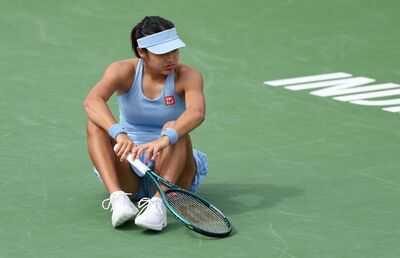
We've spent a lot of time talking about Emma Raducanu's struggles over the years. There have been divisive coaching decisions, from hiring and firing mentors to her recent declaration that she's happy to spend periods of her career without a head coach. There have also been physical setbacks aplenty, with wrist and ankle surgeries forcing the British No. 1 to end her 2023 season early, while she has continued to struggle with injury and illness issues on the court, retiring from 10 matches since her WTA Tour debut in 2021.
In that time, Raducanu has still enjoyed plenty of success. Outside of her historic 2021 US Open title, she's earned three top-10 wins, made it to a WTA 1000 quarter-final in Miami last year, and recently finished runner-up in Cluj, also returning to the world's top 25. However, throughout all the highs and lows, one thing has stayed the same, and it doesn't look like it will change, no matter how physically fit she is, or who her coach is - or isn't.
There remains a clear gap between Raducanu and the players at the very top of the game. It was evident in her 2025 Grand Slam season. Raducanu suffered one-sided defeats to Iga Swiatek and Elena Rybakina at the Australian Open, the French Open, and the US Open. She made it a little closer against world No. 1 Aryna Sabalenka at Wimbledon but was still beaten in straight sets. And her latest loss, a brutal 52-minute thrashing at the hands of Amanda Anisimova, is proof that the gap is as big as ever.
Raducanu actually beat Anisimova twice in early 2025, once at the Aussie Open, and again a matter of weeks later in Miami. Then, things changed. Anisimova reached back-to-back Grand Slam finals at Wimbledon and the US Open and cemented herself as one of the world's best players. In between those two runner-up appearances, she beat the Brit 6-2 6-1 in Canada. And she was even better when they met in the third round of Indian Wells this past week, dropping just two games in a ruthless 6-1 6-1 thumping.
Raducanu herself admitted that she fell short against the top players. "When I'm playing someone who's at the top like that, I think they have an extra 10 miles an hour on their serve than me. If I'm not feeling it, that gap feels more evident in terms of weight of shot, in terms of power," she said. And it shows on the court.
Nobody can ever take away the fact that Raducanu won a Grand Slam title, much less as a teenage qualifier ranked at No. 150 in the world. But the tour is not what it was when Raducanu stormed to the US Open title as an 18-year-old, playing only her fourth tour-level event. Back then, Iga Swiatek had one Grand Slam title to her name. Aryna Sabalenka had never even made it to a Major final. Coco Gauff and Elena Rybakina had yet to lift titles at the biggest tournaments in tennis, while Anisimova had only been to the second week of a Slam twice in her career.
Instead, the women's circuit was in something of a transitional phase during Raducanu's stellar victory. Osaka had started to struggle. Ash Barty was the dominant world No. 1, but she'd won Wimbledon earlier that summer, and we've since learned that she almost retired after that win, so her motivation understandably waned for the next few months. Barty lost to Shelby Rogers in the third round of that US Open. Coincidentally, she would have faced Raducanu in the very next round, had she not been knocked out at that stage.
Right now, the women's tour is probably in the healthiest position it has been since the Serena Williams era, when the iconic American battled with the likes of Victoria Azarenka, Angelique Kerber and Maria Sharapova. And Raducanu, even by her own admission, isn't at the point where she can rally with the dominant cohort at the top of the game

It's not just the fellow Grand Slam champions in Sabalenka, Swiatek, Gauff and Rybakina she needs to start beating. It's those who are right at the top, going the distance almost every week, even without a Major to their name, like Anisimova and Jessica Pegula, though Raducanu does have one career win over Pegula in Eastbourne two years ago.
And even more talented stars are emerging. Mirra Andreeva is still only 18 years old and has two WTA 1000 titles to her name. Her results haven't been ideal of late, but she's still a force to be reckoned with. Iva Jovic only turned 18 in December, but she won a WTA Tour title last year and then backed it up by reaching the Aussie Open quarters in January; now she's a top-20 player.
Victoria Mboko burst onto the scene last year when she won the Canadian Open as a teenage wildcard. In just over a year, she's gone from outside the top 300 to No. 10 in the world. And she handed Anisimova a brutal defeat of her own in Indian Wells, taking out the sixth seed 6-4 6-1 in commanding fashion. Maybe Raducanu should watch that one back.
Raducanu has been open in recent weeks about her desire to get back to playing the way she used to. Perhaps that will help her be more competitive against Sabalenka and co. And there have been flashes - she pushed the world No. 1 to a final set tiebreak in Cincinnati last year, ironically when she first started working with Francisco Roig, with whom she split in January. But at this stage, the gap seems too wide. Raducanu is already rediscovering the way she wants to play, she's reunited with Mark Petchey, and she still came up very short against Anisimova. The world No. 24 could 'fix' everything she is criticised for, and the best players will still be a large step ahead.
-
Four more held in gangster murder case in Kollam

-
Three reserve police officers killed in accident near Challakere

-
Academies should work to ensure languages do not go extinct: Minister Dinesh Gundu Rao

-
Amit Shah Unveils ₹2,092 Crore Health Projects in Assam

-
FASTag annual pass fee revised to Rs 3,075 from April 1 for FY27: NHAI
