Russian traveller, now settled in India, shares 12 things that surprise her the most in this country
ETimes | May 20, 2026 5:39 PM CST
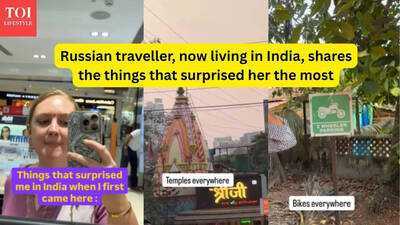
India can be surprising to first-time visitors not because of its monuments or famous tourist spots but because of some small things that locals do not notice anymore. Exactly this idea is reflected in a recent video posted by Alena Kovpar, who is a Russian national now living in India and who listed the things that have truly surprised, confused, or amazed her since moving there.
It is not about elephants on the road or very spicy foods.
One of the first things that Alena Kovpar noticed is the abundance of stray dogs on Indian streets. While in other countries, particularly European ones, you would not expect to encounter any stray dogs walking around towns and cities, in India, street dogs are just a normal part of city life; you may find them sleeping outside shops, crossing the road, or becoming local pets.
An unexpected cultural encounter was the sight of people going about their business in doctors’ clinics in bare feet. To many Indians, it is natural to remove their shoes before entering such places since it is related to notions of cleanliness and culture brought into these indoor environments from the homes and temples. However, to those who have no prior experience of this custom, the sight of footwear lining up outside a doctor’s clinic may seem very odd indeed.
Another unexpected cultural experience that surprised her was that of Indian construction sites, including workers scaling bamboo scaffolding towering over them, usually without wearing any heavy equipment that is common in other parts of the world. The use of bamboo scaffolding in construction has been an old tradition in South Asia due to its affordability and flexibility; however, to others, it may appear surreal.
But then there was the noise.
It was not a single type of noise, rather all noises put together. Constant honking, traffic, street vendors, celebrations, construction work, speakers blaring, and crowded streets.
However, not all her observations were culture shocks in a bad way. There were many things that she found interesting.
For example, she was talking about the presence of temples everywhere, either situated among shops, concealed in residential colonies, located along highways, or just appearing out of nowhere at the busiest markets. It made her realize that spirituality is an integral part of Indian life rather than something separate from it.
Another thing that could not be missed was the passion for gold and jewellery characteristic of India. Whether weddings, festivals, family rituals, or even fashion trends, there will always be something made of gold.
Finally, there was the issue of clothes. She mentioned being fascinated by how colourful and beautiful the clothing is in India and how affordable it is too. Markets full of kurtas, sarees, fabrics, embroidery, and street fashion will certainly seem overwhelming to those who come from somewhere else.
Another thing she noted immediately was just how densely populated the residential areas could be. In most Indian cities, houses, shops, scooters, food stalls, and even temples all exist together in very compact spaces. As an outsider, the level of chaos and efficiency that exists in these urban environments is something one could only marvel at.
And then there were the bicycles.
Scooters and motorbikes are a dime a dozen in India, zipping around in traffic, parking in spaces one would never have imagined, ferrying groceries, furniture, and sometimes even entire families. For those used to cars ruling the roadways, Indian traffic can seem like a totally different planet altogether.
One thing that caught her off guard was the presence of India’s significant Christian populations. Coming into India with stereotypical notions about its religious demography, many foreigners are taken aback by the country’s diverse communities, including the historic presence of Christians in states like Kerala, Goa, and the Northeast.
Food, needless to say, found its place on the list too.
She had joked about how big the thalis were in India, with the food portions seeming huge to her compared to what she was used to. One of the things that a lot of tourists come across when visiting India is the concept of a thali, which is an important part of Indian hospitality, where feeding people is as much a part of the experience as anything else.
However, the thing that must have been funniest for her to notice would be something that millions of Indians do not even think twice about: movie intervals.
While in other countries movies tend to go uninterrupted, in India it is customary to take breaks during movies to grab some snacks, have tea and chat and build up suspense before the second half. For a new visitor, such a break in the middle of watching a movie might seem almost like a theatrical performance.
What makes her observations resonate online is that they are neither exaggerated nor overly sentimental. They capture the strange gap between what Indians consider completely ordinary and what outsiders often find unforgettable the moment they arrive.
It is not about elephants on the road or very spicy foods.
One of the first things that Alena Kovpar noticed is the abundance of stray dogs on Indian streets. While in other countries, particularly European ones, you would not expect to encounter any stray dogs walking around towns and cities, in India, street dogs are just a normal part of city life; you may find them sleeping outside shops, crossing the road, or becoming local pets.
An unexpected cultural encounter was the sight of people going about their business in doctors’ clinics in bare feet. To many Indians, it is natural to remove their shoes before entering such places since it is related to notions of cleanliness and culture brought into these indoor environments from the homes and temples. However, to those who have no prior experience of this custom, the sight of footwear lining up outside a doctor’s clinic may seem very odd indeed.
Another unexpected cultural experience that surprised her was that of Indian construction sites, including workers scaling bamboo scaffolding towering over them, usually without wearing any heavy equipment that is common in other parts of the world. The use of bamboo scaffolding in construction has been an old tradition in South Asia due to its affordability and flexibility; however, to others, it may appear surreal.
But then there was the noise.
It was not a single type of noise, rather all noises put together. Constant honking, traffic, street vendors, celebrations, construction work, speakers blaring, and crowded streets.
However, not all her observations were culture shocks in a bad way. There were many things that she found interesting.
For example, she was talking about the presence of temples everywhere, either situated among shops, concealed in residential colonies, located along highways, or just appearing out of nowhere at the busiest markets. It made her realize that spirituality is an integral part of Indian life rather than something separate from it.
Another thing that could not be missed was the passion for gold and jewellery characteristic of India. Whether weddings, festivals, family rituals, or even fashion trends, there will always be something made of gold.
Finally, there was the issue of clothes. She mentioned being fascinated by how colourful and beautiful the clothing is in India and how affordable it is too. Markets full of kurtas, sarees, fabrics, embroidery, and street fashion will certainly seem overwhelming to those who come from somewhere else.
Another thing she noted immediately was just how densely populated the residential areas could be. In most Indian cities, houses, shops, scooters, food stalls, and even temples all exist together in very compact spaces. As an outsider, the level of chaos and efficiency that exists in these urban environments is something one could only marvel at.
And then there were the bicycles.
Scooters and motorbikes are a dime a dozen in India, zipping around in traffic, parking in spaces one would never have imagined, ferrying groceries, furniture, and sometimes even entire families. For those used to cars ruling the roadways, Indian traffic can seem like a totally different planet altogether.
One thing that caught her off guard was the presence of India’s significant Christian populations. Coming into India with stereotypical notions about its religious demography, many foreigners are taken aback by the country’s diverse communities, including the historic presence of Christians in states like Kerala, Goa, and the Northeast.
Food, needless to say, found its place on the list too.
She had joked about how big the thalis were in India, with the food portions seeming huge to her compared to what she was used to. One of the things that a lot of tourists come across when visiting India is the concept of a thali, which is an important part of Indian hospitality, where feeding people is as much a part of the experience as anything else.
However, the thing that must have been funniest for her to notice would be something that millions of Indians do not even think twice about: movie intervals.
While in other countries movies tend to go uninterrupted, in India it is customary to take breaks during movies to grab some snacks, have tea and chat and build up suspense before the second half. For a new visitor, such a break in the middle of watching a movie might seem almost like a theatrical performance.
What makes her observations resonate online is that they are neither exaggerated nor overly sentimental. They capture the strange gap between what Indians consider completely ordinary and what outsiders often find unforgettable the moment they arrive.
READ NEXT
-
Asda launches major in-store change to UK supermarkets - 'see the difference straight away

-
Asda launches major in-store change to UK supermarkets - 'see the difference straight away

-
Delhi government launches 'Flight of Aspirations 2026-27' talent hunt scheme
-
Fury as Rachel Reeves plots 'cruel' new 'pay as you die' tax

-
13-nation military exercise begins in Meghalaya, focus on counter-terror operations