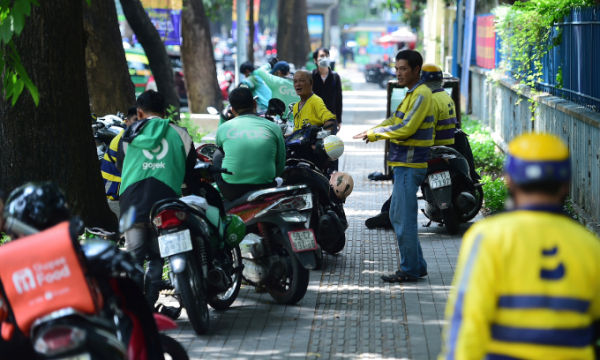
On May 10, a delivery driver in HCMC was allegedly beaten by a customer for refusing to open a package containing a pet hair trimmer to be tested on their dog. The driver suffered a nose injury, and the police called in the assailant the next day for questioning.
It was one of several recent attacks on drivers. In late March, a woman driver in HCMC was assaulted outside a hotel after an argument over a delivery location. According to local media reports, about 20 assaults on ride-hailing drivers have been recorded from late 2024 to the present. The most serious case was the death of a delivery driver in Da Nang in early 2025.
Video footage of the male delivery driver assaulted on May 10 and the female driver assaulted on March 15. Video by Read
The increase in violence has come as Vietnam’s gig economy expands rapidly. The country’s online food delivery and ride-hailing market is expected to exceed $11.5 billion by 2030, according to Ipsos, a global market research firm.
Nearly a million workers are estimated to depend on the sector, according to Friedrich-Ebert-Stiftung Vietnam, a labor-focused research organization. Most drivers are classified as “partners” rather than employees, meaning they do not receive a base salary, health insurance or unemployment benefits.
More importantly, the “partner” model offers few protections for workers’ safety. On the streets, drivers face the risk of accidents and violence from customers; on the platform, they are monitored and penalized by algorithms.
Rules of the algorithm
When Vo Thanh, 27, was confronted by a passenger who refused to wear a helmet and threw it to the ground on the evening of March 15, he chose to stay silent and complete the trip.
“I could tell the passenger was drunk, so I knew there was a risk. But I didn’t dare cancel the ride because I was afraid the system would lower my acceptance rate,” he says.
During the trip, the passenger told Thanh to take a different route and repeatedly insulted him. Thanh eventually argued back. After the ride ended, the passenger threatened to report him to the platform and get him removed from the app.
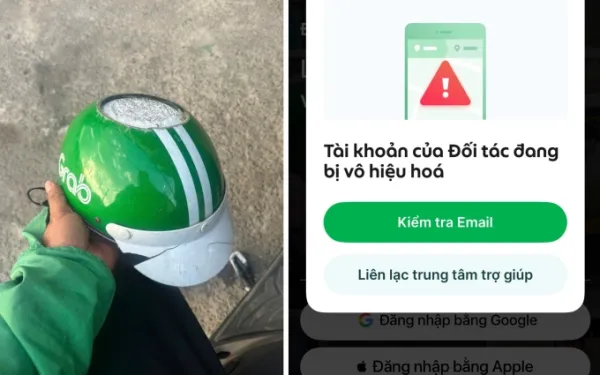
Two days later, the company contacted Thanh to investigate the complaint. Thanh said he had been verbally abused first, but the platform permanently deactivated his driver account for what it called a violation of its code of conduct.
 |
|
Vo Thanh after being hit with a helmet by a passenger and having his driver account deactivated in March 2026. Photo courtesy of Thanh |
Nguyen Hung, a ride-hailing taxi driver in HCMC, faced a similar situation. On the evening of March 10, he was driving a group of passengers into a residential area and stopped at a security gate to ask for directions. A passenger in the back hit him on the shoulder and shouted at him.
Hung later posted dashcam footage of the incident on social media without blurring the passenger’s face. After the passenger filed a complaint, the platform permanently deactivated his account.
“It was wrong to post the passenger’s image, but the platform only punished the privacy violation and ignored the threats against the driver,” Hung says.
Asked by Readthe ride-hailing company said Hung’s account was suspended after an internal review.
“The driver had disclosed a passenger’s personal information. The company requested that the violating content be removed, but received no cooperation for three days, and therefore took disciplinary measures.”
Valerio De Stefano, a scholar of digital-era labor law at Osgoode Hall Law School in Canada, says the legal gap surrounding platform labor models is the root cause of the issue.
The greatest paradox of the platform economy is that companies position themselves as intermediaries rather than employers, yet their algorithms directly assign work, monitor performance, control income, and determine drivers’ right to work, he points out.
Platforms also have the power to reward, punish, or deactivate accounts through a one-sided rating system, he says. “When a platform can reward, punish, lower rankings or deactivate accounts through a rating system, that level of control can match or exceed traditional employment management.”
Data from Friedrich-Ebert-Stiftung Vietnam shows 63% of drivers have faced safety risks while working. On average, drivers earn 16.6% less than the minimum living standard. Many work 11 hours a day to make about VND9.2 million, or roughly $360, per month. Some 62% said they had no chance to explain themselves when penalized by the system.
|
Ride-hailing drivers in central Ho Chi Minh City in 2025. Photo by Read/Thanh Tung |
Pham Truong Son, chairman of the Southern Nonprofit Organizations Community, describes this as a “partner trap” marked by a power imbalance that pushes many workers into a dilemma.
Drivers often avoid confronting abusive passengers because complaints can lower their ratings and reduce future bookings, but platforms do not take legal responsibility for protecting workers that traditional employers usually have, he says.
He proposes creating a driver protection association in Vietnam modeled on similar associations in Thailand, saying such an organization can help drivers negotiate with multinational technology companies.
According to De Stefano, governments and international organizations are paying closer attention to how platforms use algorithms to manage workers.
Globally, the International Labour Organization is discussing a new international agreement to protect platform workers, focusing on employment status, workplace safety, and transparency in how algorithms make decisions.
Meanwhile, many drivers choose to leave. Thanh and Hung switched to new apps, but realized that the rules there too mainly favor passengers.
Hoang Tuan Hien, 40, of Ho Chi Minh City, quit after two years as a ride-hailing driver. He says the hardest part was not the lack of a steady income, but feeling unsupported when there were problems. After receiving a one-star review from a passenger who blamed him for traffic delays, he quit.
“When I stopped driving, I finally felt at peace,” he adds.
-
‘Things Could Get Out of Hand!’ 14,000 Fans Demand Free Access to World Cup Opener and Warn FIFA of Possible ‘Escalation’

-
Reece James explains why he hasn’t sought sister Lauren’s ‘winning advice’ as England’s Three Lions aim to match the Lionesses’ glory

-
Profile Comparison: Goalkeeper Targets of Persib Bandung and Persija Jakarta, Major Market Value Gap and Career Records

-
Indonesian League Star Frans Putros Joins Iraq Squad for 2026 World Cup, Persib Defender Thanks Bobotoh Fans

-
Chelsea’s Kendry Paez faces uncertain future as club prepares Stamford Bridge return: report