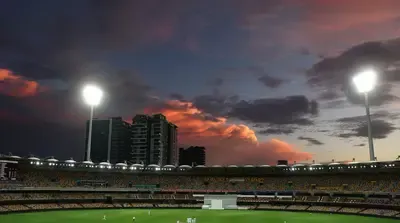
The England Cricket team led by Ben Stokes will look for an equalizer against Australia in the 2nd Ashes match today at the Brisbane Cricket Ground Woolloongabba, popularly known as The Gabba, aka the Australian Fortress. Gabba, located in the suburbs of Brisbane’s suburb of Woolloongabba, is a renovated spectacle but has century-old histories buried under the 22-yards.
Gabba is popular for his pace-friendly pitch, offering awkward bounce. The outfield is notoriously fast, having brutal records of Simon Jones' injury while saving Ricky Ponting's drive with a slide. Jones had ruptured his anterior cruciate ligament while jamming his knee in the grass and was carried out on a stretcher.
Ashes often recalls hissing faces but carries history that we will recall before the toss happens.
The first match in Gabba
Local authorities had had granted a lease over a swampland to Queensland Cricket Association, located near the suburbs of Woolloongabba, which locally means ‘whirling waters.’ The swampy reserve was drained and filled — the ground authorities reportedly used tens of thousands of tons of fill material to make it usable
The field was match ready by 1895, however the first officially recorded match was hosted in 1896- between the Parliament and The Press.
Prior to this, major cricket events in Brisbane were staged elsewhere—notably at the city Exhibition Ground or “Albert Sports Ground” before QCA turned its attention to Woolloongabba.
Notably, the first Test match at The Gabba was played between the Australia national cricket team and the South Africa national cricket team, from 27 November to 3 December 1931.
Over time, the ground became commonly known as “The Gabba” — a shorthand derived from its location in Woolloongabba.
Multi-sport Purpose: Beyond Just Cricket
Like many stadiums in Australia, the Gabba has also traditionally been a multisport field. Athletics, cycling, baseball, rugby league and union, soccer have all found a home here. Notably, in 2000, Gabba hosted the Olympics, and will be hosting the
Since the early 1990s, the stadium has become home to Australian Football League (AFL) side Brisbane Lions (originally the Brisbane Bears), meaning football codes converted to the oval shape as well.
One of the most unique features the old Gabba had was a greyhound racing track. It was adog track at the periphery of the ground. However, in the 1990s, it was moved as the stadium underwent renovation.
Read also: Cricket Tales: When VVS Laxman shouted on Pragyan Ojha in 2010 India vs Australia at Mohali
Renovations & Modernisation
From 1993 to 2005, the Gabba underwent a six-phase renovation that cost AUD 128 million. A stadium that has open grassy banks, Moreton Big fig tress and the greyhound racing track now has cement-based galleries, enhanced player facilities and media rooms that replaced the old suburban charm to become a corporate stadium.
- In 2005, the 24-bay grandstand or the three-tiered seating system was introduced, which modernized the stadium. With this, the seating capacity upgarded to approximately 45000.
- Installation of floodlights, video screens, and upgraded public, media, and corporate facilities — bringing the venue up to modern standards for cricket, AFL, and night matches.
Pitch & Bowling end history
The pitch usually aids fast bowling, aiding swinging seamers and fast bowlers. The second Ashes Test between Australia and England is a pink ball Test. Well, even though the pitch will be fast at the start, it will slow down at the end. Thus batter, who will have patience to survive the early bounce, will get runs at the end.
However, the field has two ends with odd names given by locals- the Vulture Street end and the Brown Snake end. Sounds haunting, but its simple. The Vulture street, named after the Royal Navy ship HMS Vulture in the 1850s, is one of the oldest roads in Woolloongabba, existing long before Gabba came on the scene.
And so for the Brown Snake? Its a nickname to the Brisbane river. Locals reportedly began calling the river “the Brown Snake” because of its long, winding course and the brownish, silty water, which reminded people of a slithering snake
Head-to-Head: Australia vs England at The Gabba & The Ashes
Historically, England have struggled at The Gabba — often referred to (by Australian fans) as the "Gabbatoir." Normally, "abattoir" means a slaughterhouse, and Gabba feels nothing less for the opponents.
Across all Ashes Tests at Brisbane, England has claimed only 4 Test wins (1933, 1936, 1978, 1986) out of 22 or so played there. England’s last Test win here came in November 1986, when Ian Botham scored 138 and pacer Graham Dilley took five wickets after Australia was forced to follow on.
Recent Australia v England at the Gabba
| Series | Result |
Margin |
Series Result |
| 1986-87 |
England win |
7 wickets |
Aus 1 Eng 2 |
| 1990-91 |
Australia win |
10 wickets |
Aus 3 Eng 0 |
| 1994-95 |
Australia win |
184 runs |
Aus 3 Eng 1 |
| 1998-99 |
Drawn |
|
Aus 3 Eng 1 |
| 2002-03 |
Australia win |
384 runs |
Aus 4 Eng 1 |
| 2006-07 |
Australia win |
277 runs |
Aus 5 Eng 0 |
| 2010-11 |
Drawn |
|
Aus 1 Eng 3 |
| 2013-14 |
Australia win |
381 runs |
Aus 5 Eng 0 |
| 2017-18 |
Australia win |
10 wickets |
Aus 4 Eng 0 |
| 2021-22 |
Australia win |
9 wickets |
Aus 4 Eng 0 |
The endgame for Gabba
The stadium now holds a legacy of over 130 years, and it's about to get demolished! The Brisbane Stadium had got the right to host the 2032 Summer Olympics. There were planning to rebuild the Gabba into a 50,000-seat stadium at a projected cost of A$1 billion. By 2023, the estimate had soared to A$2.7 billion, paid entirely by the state, sparking heated debates across political lines and intense scrutiny from media, opposition parties, and local communities.
Questions over taxpayer money and the escalating price tag made the redevelopment a highly controversial issue.
Following reviews and government changes, authorities scrapped the Gabba rebuild in favor of a new 63,000-seat stadium at Victoria Park, now progressing steadily through planning and early construction. This modern venue will host cricket and all other major sports after the Olympics, signaling the inevitable closure of the Woolloongabba icon. As per plans, the Gabba will be demolished and residential complexes will be built there.
-
MP FSO Admit Card 2025: Admit card released for Food Safety Officer Recruitment Exam, download now..

-
Google: No more hassles of returning clothes after ordering them online. Try on clothes with Google's 'Try It On' feature...

-
AI: Government cracks down on fake news and deepfakes; new rules for social media, mandatory action within 36 hours..

-
WhatsApp Tips: Troubled by repeated unknown WhatsApp calls? This simple setting will help you get rid of them...

-
YouTube Recap: This amazing feature of YouTube will soon be launched in India, the company has given a big update..